

In honor of this month’s 35th anniversary of Chris Whitley’s debut, ‘Living with the Law’, here’s a piece I had to cut from my upcoming book on Swamp Rock (details to come on that). It’s an outtake from a chapter detailing the New Orleans trilogy of albums produced by Daniel Lanois at the dawn of the 1990s (‘Yellow Moon’ by the Nevilles, Bob Dylan’s ‘Oh Mercy’, and Lanois’s own ‘Acadie’). I’m sharing it here as an exclusive to Mixtape subscribers. It also covers Lanois’s ‘90s work with Emmylou Harris as well as on Billy Bob Thornton’s film ‘Sling Blade.’
Dust Radio
With the completion of his New Orleans trilogy, the hypnotic vibe of the Paris of the South led Daniel Lanois not only to linger there but also to expand. He moved to a building at the corner of Esplanade and Chartres, one block away from the French Market. Built in 1848, Kingsway boasted 12,000 square feet of space for Lanois and his clients to create, play, record, imagine, and dream. Throughout the 1990s, the studio was home to everyone from R.E.M., Pearl Jam, and Sheryl Crow to Lanois regulars U2, Robbie Robertson, Bob Dylan, and future client Emmylou Harris.

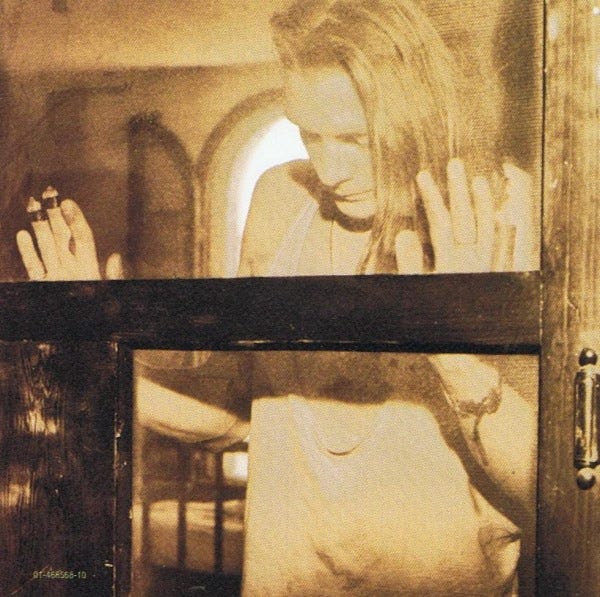
One of the artists who recorded at Kingsway early on was Chris Whitley, a singular and tortured artist who wore the blues like a second skin. Unlike many of the be-hatted white boys that popped up after Stevie Ray Vaughan hit it big, Whitley seemed to be from another time, or out of time. Wide-eyed both physically and musically, he traveled effortlessly between dusty Delta blues, swampy grooves, dance beats, and grungy distortion. All the while, he remained restless, curious, and cursed.
A Houston native, Whitley moved with his family from Texas to Oklahoma and then to Connecticut before he turned ten. After his parents divorced the following year, he moved with his mom and siblings to an artist colony in Mexico, then on to Vermont. In 1977, after quitting high school, Whitley moved to New York City, where he started busking, making demos, and joining various bands. By 1981, while performing in Washington Square Park, Whitley was noticed by a Belgian travel agent and was whisked away to Belgium, where he fell into the local artist scene and formed the band Noh Rodeo. He remained in Belgium for most of the decade, where he played on various artists’ albums in varying styles, wrote songs, made more demos, got married, and returned to NYC in 1988 with his wife, Helene, and their one-year-old daughter, Trixie, in tow.
While back in New York, Whitley met Lanois through photographer Karen Kuehn, who was dating Lanois at the time. Impressed, Lanois invited Whitley down to New Orleans to stay at Kingsway. Eventually, Whitley secured a publishing deal through the demo he’d recorded in Belgium and, after a bidding war between several labels, signed with Columbia. He then started working at Kingsway with Lanois’s engineer, Malcolm Burn (Lanois was holed up in Ireland at the time with Brian Eno on the sessions for U2’s Achtung Baby), on what would become Living with the Law.
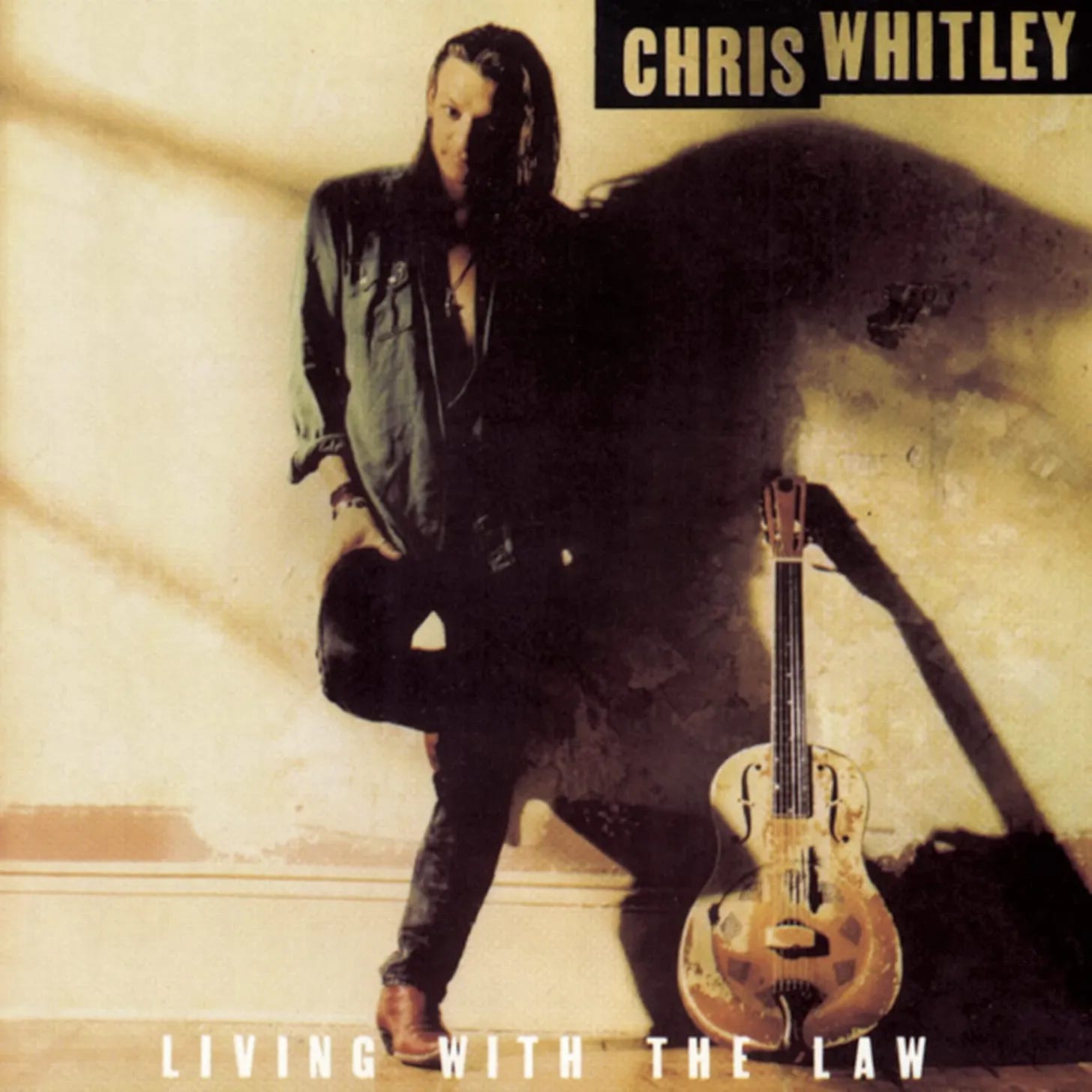
Burn told David Wild of Rolling Stone at the time, “We wanted to make an album that had the blues as a strong musical element, but we also knew we couldn’t just make a traditional blues record. That’s not what Chris is all about. We were both fascinated by the way a group like Led Zeppelin took the blues in a different direction.”1
Living with the Law was released amidst the sweltering heat of July in 1991. Being issued at the height of the summer made perfect sense; you could practically smell the sweat flowing from the speakers. It sounded like nothing else on the radio at the time. In fact, it sounded as if it came from outer space—or out of the dust. Hellhounds were on Whitley’s trail throughout Living With the Law. It was his debut, but, as Mack McCormack said of Robert Johnson in the documentary Searching for Robert Johnson released that same year, there was “already a sense of time running out.” Darkness surrounds its borders, but its raw beauty is unrelenting. Dirt, abandoned cars, dilapidated shacks, dusty tools scattered about—it was an album that sounds like no other from an artist that was both behind and ahead of his time.
“Chris made his music at a time when the cowboy boot was frowned upon,” Lanois wrote in Soul Mining. “His images of the big skies of Texas and his romantic association with the Dobro were not in step with the journalist’s desire for the urban and the new.”2 The dobro in question was undoubtedly “Mustard,” a National Triolian picked out for Whitley by fellow blues guitarist John Campbell.3
Originally from Shreveport, Louisiana, Campbell had also migrated to New York, and by the late 1980s was working at a guitar store and suggested the guitar to Whitley, saying it was “a special one.” “Mustard” (named for the mustard paint that was mostly gone by this point) became the sonic cornerstone of Living with the Law, and of Whitley’s sound in general, for most of his career.4
Following the critical success of Living with the Law, which earned him the opening slot on the Tom Petty and the Heartbreakers Into the Great Wide Open tour that year, Whitley contributed to the soundtrack of the 1993 dark comedy, So I Married an Axe Murderer, sharing space with the likes of severely ‘90s acts Ned’s Atomic Dustbin, Soul Asylum, Spin Doctors, and Toad the Wet Sprocket.
He then pivoted for Law’s follow-up, 1995’s Din of Ecstasy. Enlisting producer John Custer (who’d helmed projects by hard rockers Cry of Love and heavy-hitters Corrosion of Conformity), he opted for a harsher, heavier sound that was more post-grunge than Delta blues (including a beautifully noise-centric take on the Jesus and Mary Chain’s “Some Candy Talking”). Yet, even though it wasn’t what the label wanted at the time, with Whitley saying some of Columbia’s execs “wigged out” when they first heard it,5 it somehow still worked.
Throughout the rest of his career, Whitley experimented, diving into industrial blues, hard rock, off-kilter jazz, hip-hop textures, and frantic folk. All his work deserves—and rewards—close examination: from Ecstasy, 1997’s Terra Incognita, and 1998’s sort-of return-to-form all-acoustic and solo Dirt Floor to 2001’s exquisite, experimental Rocket House and beyond.
Released in July of 2005, Soft Dangerous Shores found Whitley reuniting with Burn. Shores is more dissonance than dust, an album that sounds just a bit more of its time than the timeless Law. Nevertheless, it proves that Whitley was still searching and still curious. Diagnosed with lung cancer, his roadwork to promote Shores was cut short in October. He died on November 20th, 2005.6
“He was a great singer and a deep soul diverted by the bottle at unfortunate moments in his career,” Lanois recalled in Soul Mining. “I loved Chris and introduced him to every opportunity that I could…In the end, his body wore out, and he died.”7
Here’s a 35-song Mixtape for both die-hards and the uninitiated:
Click here to access this Mixtape on your preferred streaming service.
Wrecking Ball
As usual, between 1991 and 1993, Lanois split his time on projects by others (namely U2 and Peter Gabriel) and, when he could, his solo work. For the Beauty of Wynona, his follow-up to Acadie, was released in March of ’93 and was recorded in several locations: Somerset, Paris, Dublin, Ontario, and in New Orleans at Kingsway. Populated with the usual suspects, Malcolm Burn on guitar and keys, Daryl Johnson on bass, and Ronald Jones on drums (they all also appeared on Living with the Law), Wynona displayed more of Lanois’s swampy aural magic. Of note was “Indian Red,” a cover of the George “Big Chief Jolly” Landry song that appeared on the self-titled – and only – album released under the Wild Tchoupitoulas name.
After Wynona, Lanois would spend much of 1995 working on what would become one of the highlights of his resume, Emmylou Harris’s Wrecking Ball.
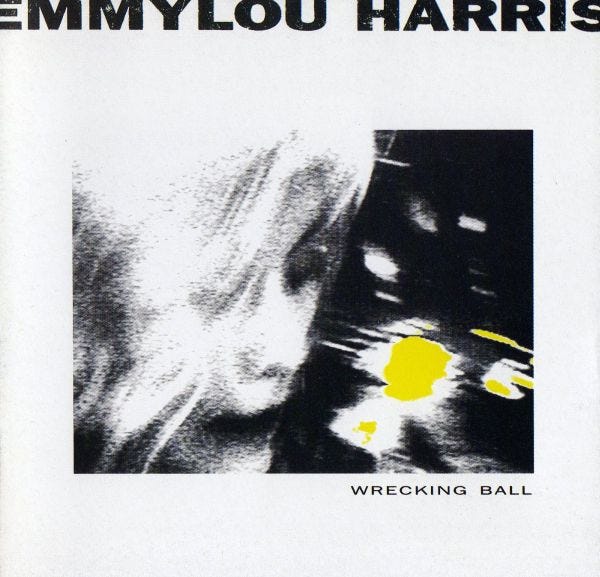
By the mid-1990s, the country radio format was more concerned with line dancing, achy-breaky hearts, and Hallmark sentimental schmaltz than anything substantial. The legends that helped shape the format in the previous decades were still around and making vital music (Willie Nelson’s Across the Borderline, Waylon Jennings’s Waymore’s Blues Part II – both produced by Don Was – are just two examples), but they weren’t receiving airtime.
Emmylou Harris came out of the 1980s and early 1990s pretty much unscathed. Her country cred had been established many years before, and she was still enjoying the occasional hit. Trio, the acclaimed collaboration between Harris, Dolly Parton, and Linda Ronstadt in 1987, became a huge hit, reaching number six on Billboard’s overall Top 200 chart, and sat for five weeks at number one on their Top Country Albums chart. It ultimately won the Grammy for Best Country Performance by a Duo or Group with Vocal, and it was nominated for Album of the Year, competing with the likes of Whitney Houston, Michael Jackson, Prince, and U2.
While Lanois was helping craft Achtung Baby, Harris performed with her acoustic lineup, The Nash Ramblers, for three nights at the Mother Church of Country Music, the Ryman Auditorium, in the spring of 1991, which was released as At the Ryman in January of the following year. Those performances, and the resulting album, helped preserve the one-time home of the Grand Ole Opry, causing renewed interest, and it remains a top concert draw to this day.
Harris’s next studio release, 1993’s Cowgirl’s Prayer, failed to reach the heights of its predecessors; it did give a nod to the Louisiana swamps with a Tony Joe White song (“High Powered Love” – a minor hit) and Lucinda Williams’s “Crescent City.” By this time, however, a younger class of country stars – from Alan Jackson and Faith Hill to Toby Keith and, of course, Garth Brooks – had taken over country radio. It was time to shift gears.
Nashville veterans Richard Bennett and Allen Reynolds had helmed Harris’s last several albums, but with diminishing returns. Her immaculate taste in picking great material notwithstanding, to appease country radio, the sound of her albums had become staid, predictable. Concurrently, the early ‘90s saw the emergence of a group of younger artists who offered an alternative to the scootin’ boots and sappy soft-rock pap of the country mainstream. Dubbed in some circles as alt-country and y’allternative in others, acts such as Uncle Tupelo, Blue Mountain, the Bottle Rockets, and Whiskeytown dipped back to the cowpunk and roots rock sound of the decade before from Jason and the Scorchers, Lone Justice, and the Long Ryders, but with a darker edge both lyrically and musically. In addition, Johnny Cash proved through the release of 1994’s American Recordings, with the help of hard rock/hip-hop superstar producer Rick Rubin, that a veteran country act could attract a new audience not only without compromising their sound, but by leaning into it by stripping it all down to the roots.
Harris heard Acadie and felt she’d found a producer who could help her realize her vision for her next album. Lanois, as it turns out, had been listening to Harris since the ‘70s, when she had broken free from the enormous shadow left by Gram Parsons after his untimely death and made her mark with a series of classic albums performed by a Hot Band of incredible players, including Elvis vets Emory Gordy Jr and James Burton. She’d also provided backing vocals on albums by such rock luminaries as Bob Dylan and Neil Young, while sharing the stage with Bonnie Raitt, Little Feat, The Band, and others.
Harris and Lanois listened to records together while discussing the project. Lanois said he imagined a sound that “would represent tradition and yet give Emmy a chance to broaden her scope.”8 Convening again at Kingsway with Malcolm Burn and Daryl Johnson, Lanois brought in U2’s Larry Mullen, Jr to handle drums. Guests from Steve Earle and Neil Young to Lucinda Williams and Kate and Anna McGarrigle contributed to their respective songs as Harris and Lanois dug deep into material old and new, known and unknown, overlooked and underappreciated. The worlds of rock, country, and folk collided, blurred, and coalesced into ghostly, swampy, aural magic.
“We were really devoted to a certain kind of sound, and I always thought that it had enough Appalachia in it for it to belong to Emmy,” Lanois explained to Roman Gokhman in Paste in 2014. “We had a little bluegrass in it, in the sense that we were using mandolin—but electric mandolin, with a mando-guitar, actually—a combination of that with the beautiful upright piano that we rented. I pulled up the dulcimer for a few songs. Those are all old-fashioned instruments, as electrified as I might have made them for the record. I think the spine of those instruments belongs in tradition.”9
Sling Blade
The allure of Acadie made its way to Hot Springs, Arkansas, when, one night while listening to “The Maker” through headphones, actor/director/musician Billy Bob Thornton discovered the sound that would frame his directorial debut.
Thornton sent a copy of the film to Lanois, then called him to ask if he liked it. “I told him I did,” Lanois revealed in Soul Mining. “Billy talked about the commitment he and all those involved had poured into the film so far and asked if he could expect the same commitment from me. I told him, ‘Yes, of course,’ he could expect at least that.”10
Lanois had recently leased an abandoned Mexican cinema house along the Pacific Coast Highway in Oxnard, California. The Teatro (Spanish for theatre) would see the creation of award-winning and critically acclaimed albums from Bob Dylan (Time Out of Mind) to Willie Nelson (Teatro) over the next few years. Lanois and engineer Mark Howard purchased parachutes from the nearby army surplus store to hang from the ceiling to deaden the sound. 16 mm film projected from the surfaces of weather balloons while a huge screen enveloped by velvet curtains stretched across the stage. With various images projected around the Teatro and the lack of natural light, the result was dark, mysterious, and inspiring.
It’s in this environment, far away from the swamps of Louisiana, that the soundtrack of Sling Blade was born. Yet, like Creedence Clearwater Revival, the sonic feel of the music made for the film evoked swamp rock in its most natural form. There was the haunting beauty of the folk standard “Shenandoah,” featuring Emmylou Harris’s angelic, lyric-less cry; the dark intensity of “Orange Kay;” the unsettling foreboding of “Asylum;” all culminating in the soundtrack- and film-closer: the Acadie version of “The Maker.”
Sling Blade was a labor of love for Billy Bob Thornton. Adapted from Swine Before Pearls, Thornton’s one-man show where he introduced the main character, the film follows Karl Childers, a developmentally disabled man recently released from a psychiatric hospital, as he befriends a young boy (Lucas Black) and his mother (Natalie Canerday). Sling Blade also starred John Ritter as Vaughan and Dwight Yoakam as Doyle, as well as an array of musicians well-known to roots rock and Americana fans – Col. Bruce Hampton (Ret.), Vic Chesnutt, Ian Moore, and Mickey Jones – who appeared as Doyle’s long-suffering band. Robert Duvall delivered an understated, yet brilliantly harrowing, cameo as Karl’s dad.
The film was shot for around a million bucks and ended up grossing over $24 million. It also became part of the cultural zeitgeist by the late 1990s, especially in the South, where it was filmed and set (in Benton, a suburb of Little Rock, Arkansas). Quite a few of Thornton’s friends – some who’d never acted before – filled supporting roles. As such, the film offered a rare, authentic, and sympathetic look at southern life without the usual overblown Hollywood stereotypes. Its power comes from its understatement, as well as Lanois’s score, which rumbles underneath throughout, offering equal measures of comfort and unease.
Le Noise
Years later, Neil Young would join Lanois’s universe after seeing his work with a group Lanois had formed with Brian Blade, Darryl Johnson, and Trixie Whitley, daughter of Chris Whitley, called Black Dub. “I had done some films with Black Dub,” Lanois told me in 2022. “We made some films in the front room of a beautiful estate in Los Angeles. Neil saw those, and they were a little bit noir, in the sense that there were no edits. It was one camera for the entire song as if the performance was witnessed by one pair of eyes. He appreciated that we were telling the song’s story with the camera. That’s how it started. And I said, ‘Ok. Come to my house. It’s a beautiful place.’ We set up all the stuff. And that’s how it happened, except we expanded and went a little more electric.”11
The result was Le Noise, an album that more than lived up to its name; overdriven guitars surround the listener, while Young’s fragile yet commanding voice cuts through the murk. In a way, it was reminiscent of Chris Whitley’s work with not only Malcolm Burn but also his journeys into dissonance and distortion. It was a welcome return to Young writing and releasing essential music again.
As far as how the name Le Noise came about: “We had a little bit of a joke going because we’re both from Canada,” Lanois explained. “I had a nickname, and he had a nickname while we were working. I called him ‘Pinecone Young,’ and I got called ‘Le Noise.’ All I ever do is fucking noise.”
Wild, David. Rolling Stone, 9/5/1991, Issue 612, 15
Lanois, Daniel. Soul Mining: A Musical Life, 204
I first saw John Campbell circa 1990 at the Cat’s Cradle in Chapel Hill, NC when he opened for Buddy Guy. I was enthralled from the first note and rushed out to pick up his major label debut, One Believer, on Elektra. Sadly, after just one more album—1993’s ferocious Howlin’ Mercy—Campbell suffered a fatal heart attack at his Manhattan home on June 13, 1993. He was only 41. While I’m not one to buy into the whole “sold his soul to the devil” nonsense, it’s quite interesting considering the roads both he and Whitley traveled and how much they tapped into that old blues spirit…so to speak.
Sherman, Tony. “A Latter-Day Folkie Gets Noisey.” The New York Times, March 26, 1995. https://www.nytimes.com/1995/03/26/arts/a-latterday-folkie-gets-noisy.html?unlocked_article_code=1.n1A.ZSB1.ThNWn0V1Myh8&smid=url-share
For much more on Whitley, his life, death, and his work, be sure to check out the excellent All Things Chris Whitley Substack.
Lanois, 204
Lanois, 135
Gokhman, Roman. “Daniel Lanois: Revisiting 'Wrecking Ball.’” Paste Magazine, April 8, 2014. https://www.pastemagazine.com/music/daniel-lanois/daniel-lanois-revisiting-wrecking-ball
Lanois, 30
Elliott, Michael. “Daniel Lanois Still Believes in Magic.” PopMatters, September 19, 2022. https://www.popmatters.com/interview-daniel-lanois-still-believes
I'll get to the rest of this but good for you for bringing Chris his due and keeping the lamps trimmed and burning.
I met Chris on Houston Street one EV afternoon just walking around. He stopped and chatted like we were old pals. He didn't know me or my friend but he knew of us and that was enough to bond right there. I'll never forget how equal we were. Us local musicians. He really made it as we used to say but what he really did was make great music from his soul. You captured that truth.
This is a keeper that will be cherished.
That’s a great piece, Michael. Some of my all-time favourite records in there, too.