
Mick Jagger's ‘Wandering Spirit’
As the Stones' return with a new album, let's look back at Mick Jagger’s third – and best – solo moment.

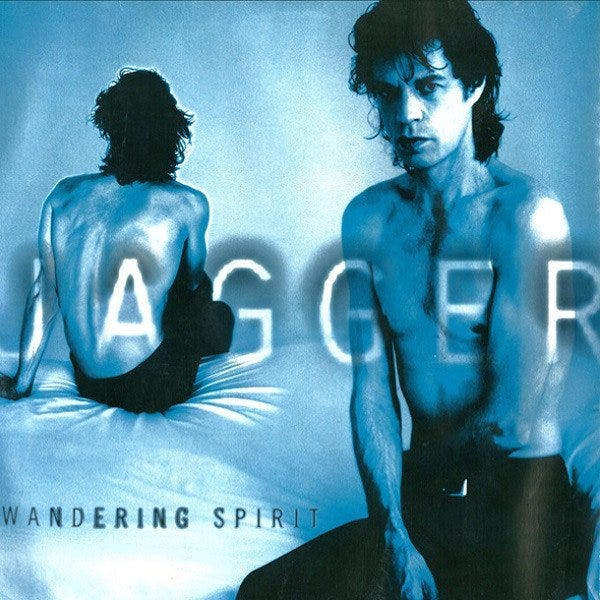
While everyone’s giving their take on ‘Foreign Tongues’ (find links to reviews at the end of this piece), I’m revisiting my favorite Jagger work outside of the Stones…
This piece was originally published elsewhere on the 30th anniversary of ‘Wandering Spirit,’ in February of 2023.
When “Sweet Thing” was released to radio in January of 1993, it sounded like the Club 54/Emotional Rescue-era Mick Jagger, but with more bite and snarl. The wacky falsetto was there, but it was less camp; it had intent. It was older and wearier. It didn’t have time for bullshit.
Set against pounding club-ready drums and percussion from Curt Bisquera and Lenny Castro, respectively, and driving bass from Living Colour’s Doug Wimbish (whom he’d joined just the year prior), “Sweet Thing” was the first taste of what would become Jagger’s most consistent album to date, the sprawling Wandering Spirit, released February 9, 1993, on Atlantic Records.
Jagger enlisted Rick Rubin to co-produce, and it shows. There’s hardly a hint of reverb. Everything is upfront, dry as a bone. The snare pops, the bass rumbles, and the rhythms are incessant throughout.
At the time of its release, Wandering Spirit fit right into the aggressive sounds that the grunge and alternative rock movements had brought back to rock radio. Not down-tuned guitars or angst-filled lyrics, it was more the aggression of the production. The return of the in-your-face aesthetic of the hard rock of the 1970s was one of the positives of Seattle’s influence. The thin digital production of the 1980s had finally been put to rest.
As for content, Jagger sharpened his pen and gave us ten originals (two co-written with Jimmy Rippentoe) that matched the intensity and durability of the four covers. Of the originals, one of his most powerful, soulful ballads became the set’s second single, “Don’t Tear Me Up.”
From hard rockers “Wired All Night,” “Mother of a Man,” the power-pop/punk of “Put Me in the Trash,” the hard soul of “Don’t Tear Me Up,” and the well-chosen covers of Bill Withers’ “Use Me” (a preening and sneering duet with Lenny Kravitz), the fantastic “I’ve Been Lonely For So Long” (a 1972 hit for Frederick Knight)—even a high-octane take on The “5” Royales’ “Think”—to the gospel-pop sensibilities of “Hang On To Me Tonight” and third single, “Out of Focus,” Wandering Spirit is Jagger’s most eclectic album outside of the Stones. And unlike his previous efforts, everything here works.
Wandering Spirit was recorded at a time when the Stones had ended their relationship with Sony and were moving to Virgin (which would release Voodoo Lounge the following year). In the meantime, Jagger went back to Atlantic, which had distributed Rolling Stones Records in the ‘70s, for this one project.
Interestingly, Jagger was recording Wandering Spirit (over seven months in 1992) at the same time Keith Richards was laying down tracks for what would become Main Offender. Pairing those albums together would make an interesting – and intense – alternate-universe Stones album.
As it stands, however, we pretty much did get that wish, as Voodoo Lounge contained the dark, raw mojo of Main Offender and the rocked-up side of Jagger’s pop tendencies – the best of both worlds.
Back to Wandering Spirit, Jagger dug back into his love of country music for the incredible “Evening Gown.” Jagger’s attempts at country can be overly camp and mocking at times, but with “Evening Gown,” he recorded one of the best country songs of the early 1990s. Country radio completely ignored it, preferring to pummel listeners with scootin’ boots and achy-breaky hearts.
In the years since, Wandering Spirit has kept itself on the periphery of the culture with the help of the likes of Jerry Lee Lewis, who included “Evening Gown” on his fantastic 2006 comeback album, Last Man Standing, with Jagger adding call-and-response vocals and Ron Wood on guitar. It ends up surpassing the original.
And most recently, country hitmaker Miranda Lambert took ownership of the gospel-fueled title track on her 2022 album, Palomino.
Lambert’s version is faithful to the original, which is appropriate, considering it falls right in line with Jagger’s fascination with what he calls “agnostic gospel” songs. One could draw a through-line, in fact, from “Sympathy for the Devil” to “Wandering Spirit” and on through “Saint of Me” from the Stones’ 1997 disc, Bridges to Babylon – and it stands as tall as either of them.
Solo Jagger would return in 2001 with the more of-the-moment—and much maligned (despite Jann Wenner’s fawning 5-star review in Rolling Stone)—Goddess in the Doorway (what Keith Richards notoriously renamed “Dog Shit in the Doorway”). To be fair, it had a couple of high points, but it couldn’t match the intensity and focus of Wandering Spirit. Over 30 years on, and 60 years-plus into his career, Jagger still sings like he has something to prove. And we wouldn’t want it any other way.
My favorite reviews of Foreign Tongues:
I’ve been listening to Foreign Tongues on a loop for the last week. Although I haven’t taken the time to write about its many pleasures, the veteran wordsmiths below mostly echo my thoughts.
Ann Powers ‘Foreign Tongues’ review for NPR
Stuart Berman Review for Pitchfork (It’s a lower score than I would've given it, but it’s a great review.)

Here’s David Marchese’s New York Times interview with Mick Jagger (Gift Article), and its accompanying video:
Conan O’Brien interviewed Jagger for his podcast:
Wandering Spirit closes with a take on the traditional Irish ballad, “Handsome Molly.” Last month, Jagger spontaneously broke it out at a British pub with a local group backing him.
And finally, find my review of the Stones’s previous album, Hackney Diamonds, for No Depression here.