
The Swamp Fox and the King
The night Tony Joe White tried to teach Elvis how to play the blues.

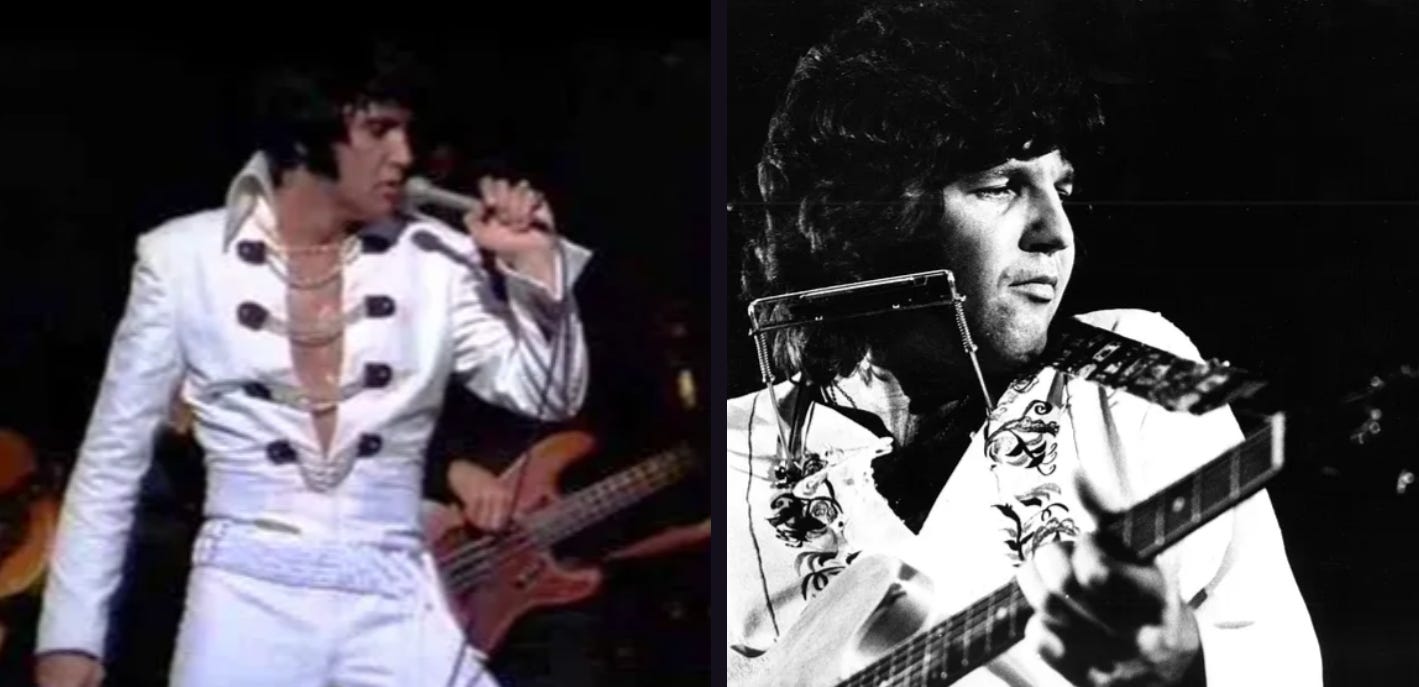
Elvis wanted to play the blues.
It was February of 1970, and Tony Joe White found himself at the International Hotel in Las Vegas, sitting in the dressing room of the King of Rock’n’roll.1 By this point, Elvis was a walking, talking, strutting, shaking, shimmying legend, quickly on the way to becoming a caricature of himself. He’d made some questionable decisions over the last decade thanks to his notorious Svengali, “Colonel” Tom Parker. All those bad movies and throwaway soundtracks still made bank, though, even if he was no longer at the center of the cultural zeitgeist. Those mop-tops from across the ocean had seen to that.
There was an acoustic guitar in the corner of the dressing room. Elvis picked it up and handed it to Tony Joe.2 “Show me a blues lick, man.” Like most every other white guy his age, Tony Joe grew up idolizing Elvis, and now the King wanted this cotton picker from Goodwill, Louisiana to teach him a thing or two on this Tennessee flat top box. What could the Swamp Fox do but oblige?
You could say, with no small hint of understatement, that Elvis was out of touch for much of the 1960s. By the time the intersection of Haight and Ashbury in San Francisco started summoning the nation’s youth like Moses to Mount Sinai, the King no longer recognized the land he’d once conquered. But by the end of the decade, time was twisting itself back around to his favor again, thanks in no small part to the Christmas special that aired in December of 1968, directed by Steve Binder. Binder had previously helmed the legendary T.A.M.I. Show, which featured incredible performances by everyone from James Brown to the fresh-faced Rolling Stones in 1964. His next big production was for the King, and it was designed to air during the holiday season. Due to its success, it would forevermore be known as the ’68 Comeback Special. Yes, it had its hokey dance numbers, but its most memorable, lasting moment came when Elvis, decked out in all leather, shunned the spectacle for once and reunited with Scotty Moore and DJ Fontana in an informal sit-down performance in what looked like a boxing ring. Right at that moment, he earned back his crown.
Elvis rode that wave of artistic credibility back to Memphis where, as 1969 got underway, he set up shop at Chips Moman’s American Sound Studio with ace players including Reggie Young, Buddy Emmons, Tommy Cogbill, Gene Chrisman, and others. There he tapped back into the same mojo that attracted him to Sam Phillips’s Sun Studios just a couple of miles south of American Sound a decade and a half before. The performances were inspired. Elvis sounded more engaged than he had in years, fueled by the response from the Christmas special. It caused him to keep pushing, keep searching, keep reaching for music that spoke to him. Music that reminded him of his roots—before Hollywood, before the glitz and long black limousines, before Las Vegas—music that reminded him of his youth in Tupelo.
“Could you show me that lick again? The one you played last night?” Elvis was prodding the younger star for another lesson. The King loved the blues. He felt the blues. Most importantly, he had lived the blues. Elvis grew up poor in both Tupelo, Mississippi, and Memphis, Tennessee. He had lived in assisted housing. He’d never picked cotton like Tony Joe, but he’d damn sure eaten polk salad. His mama had never been on a chain gang, but his dad had spent time in prison. Elvis and Tony Joe shared plenty of common ground. They had more in common with each other than most people who’d later cover this song about a girl that could make alligators look tame, that’s for sure. Most folks that bought the record or cranked it on the AM dial as the ‘60s gave way to the ‘70s had no idea what polk salad even was, and Tony Joe knew that. That’s why he explains it up front, almost like he knew it was going to be a hit, that it was going to be played and heard by folks that had never been down south too much, if at all. To most folks up north and elsewhere, the American South was not a place they desired to visit at that time. But both Tony Joe and Elvis knew that no matter where it was played or who was hearing it, one thing was universal and undeniable: that swampy, dirty, bluesy groove.
Someone else who understood all this was Felton Jarvis. Felton had moved up to Nashville from Atlanta and had started working under Chet Atkins at RCA, producing for the likes of Tommy Roe (1962’s “Shelia”). Chet decided that Felton would be a better producer for the King, mainly because the two preferred late-night recording marathons. This suited Jarvis just fine since he’d been an Elvis fanboy since first seeing him open for Hank Snow back in ’55. He began producing Elvis in 1966, and by 1970, Felton had quit RCA to become Elvis’s exclusive producer. He looked for material that he felt suited the King’s taste, voice, and image. It just so happened that this coincided with a change in the musical culture. Artists like Bob Dylan, the Band, the Rolling Stones, and even the Beatles had shunned the psychedelic excesses of the last few years in favor of a more organic sound, similar in spirit to the sides Elvis had been cutting at Sun in the mid-‘50s. Not just musical, but lyrical concerns were becoming more down-to-earth, yet detailed, topical, and, most of all, relatable.
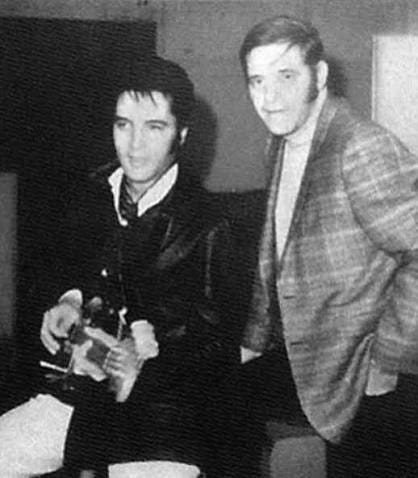
At the forefront of this return to roots was Bobbie Gentry’s “Ode to Billie Joe.” Released in the summer of 1967 – several months before Dylan’s stripped-down classic John Wesley Harding and a full year before the Band’s groundbreaking debut, Music from Big Pink – Gentry’s song was rich with detailed ambiguity. It was haunting, mysterious, almost otherworldly to those who grew up in cities, especially in the northeast or on the west coast. Yet for those raised similarly to Gentry, herself a native of Chickasaw County, Mississippi, it was as if their lives were finally given legitimacy on the pop charts. Tony Joe, a year-to-the-month younger than Gentry and who grew up about four hours southwest of her, took notice. It was “Ode to Billie Joe” that motivated him to write about what he knew, what he saw, what he experienced. So “Billie Joe” begat “Polk Salad Annie.” And now “Annie” was allowing Tony Joe to have an audience with the King.
“Man, I need you to run that lick by me again, I keep forgettin’ it.” It was the third night of a week Tony Joe and his wife, LeAnn, were spending in Vegas, watching his idol perform his song, “Polk Salad Annie,” for a packed house. Not only that, but recording it each night for a proposed live album. Tony Joe was there by the invitation of Felton Jarvis on behalf of the King. Jarvis had assembled many of these new songs that had been spilling out from songwriters’ pens from all over since “Billie Joe”—songs that detailed the struggles and concerns of the working class. These weren’t about bearded rainbows or whatever the hell those loud-ass bands at the time were singing about. These were songs about empathy toward your fellow man (Joe South’s “Walk A Mile in My Shoes”), about working for the man every night and day (Creedence Clearwater Revival’s “Proud Mary”), about lazy daddies with bad backs and watermelon-stealing siblings. Real life. Hard life. Songs by grown-ass people about grown-ass concerns. That’s why Tony Joe was holding court with the King each night in his dressing room, trying in vain to show him a handful of blues licks.
Not that Elvis needed to learn them. All he mainly did was wear his guitar around his neck and hit a chord every so often. Why would he need to know any licks with James Burton behind him? Still, as he’d proven on that Christmas special, he could peel off a nasty Jimmy Reed-style rhythm with a run or two here and there when prompted. Maybe he secretly wanted to do more of that, but there were just too many demands on the King’s time for him to sit and practice blues runs. Besides, no one was buying tickets to Elvis’s concerts to see him play lead guitar.
To Tony Joe, the scene was surreal. All those years of listening to his own music-loving family sit out on the porch after a long day in the cotton field, playing guitars and singing country and gospel songs had led to this moment. Watching Elvis shake his unmentionables on TV, scandalizing a nation, inspired Tony Joe – and so many others – to try to figure out how to make noise on that flat-top box. He was cut from the same cloth as Elvis all right. Both were naturally good-looking, effortlessly sexy, thoroughly polite southern gentlemen by nature. Where Elvis had snuck across the tracks to hear Black gospel and blues music, Tony Joe heard it all around him. When one of his older brothers brought home a record by Lightnin’ Hopkins, Tony Joe, just like Elvis, got hypnotized by a mojo hand.
The King would go on to record two more Tony Joe White songs over the next three years, and four years after that, he’d be dead. But back on that fateful night, just before their summit ended, the Swamp Fox extended an invitation to the King, as White later recalled. “I was getting ready to leave, and I said to Elvis, ‘If you want to go fishing and hang out, I got a place up in Arkansas where nobody’d give you the time of day.’ After I left, Elvis turns to [actor James] Brolin and says, ‘Can you believe Tony Joe asked me to go fishin’?’” The King had held court for so long by this point and was so far removed from those days growing up in Tupelo, the idea of baiting a hook sounded completely foreign to him. “Here was someone who was taking a jet plane to Dallas to get a cheeseburger,” White lamented. “So, watching a fishing pole might have been a little slow.”3
Maybe, however, for about five minutes or so each night amongst all the glitz and glamour on that Vegas stage, Elvis could escape the bright lights, the rhinestones, the capes, the Colonel’s shady deals, the demands of being rock’n’roll royalty fighting for relevancy in a new age, and head back to a simpler time. Back down south. Where polk salad was about all he had to eat.
But he did all right.
Tony Joe White died in 2018 at age 75, just a month after releasing Bad Mouthin’ on Yep Roc. That album revisited some of White’s earlier material as well as covers of some of the blues that inspired him all those years ago as a kid digging on Lightnin’ Hopkins.
In February of 2026, Baz Luhrmann—director of the 2022 biopic, Elvis—released EPiC: Elvis Presley in Concert, a film made up of unseen archival footage from two concert films, Elvis: That’s the Way it Is, and Elvis On Tour from 1970 and 1972, respectively. Among the found and restored footage is a performance of “Polk Salad Annie,” edited and made into a montage of different performances mainly from his residency in Las Vegas. In a film that captured the King of Rock’n’Roll in all his sideburned, rhinestoned, becaped glory, the “Polk Salad Annie” segment was one of the most exciting moments, proving the durability of a song about a mess of polk salad and the girl that carried it home in a tote sack. Although he doesn’t make an appearance in the film, it’s possible Tony Joe White could’ve been backstage, showing Elvis a blues lick or two on that Gibson SJ-200.
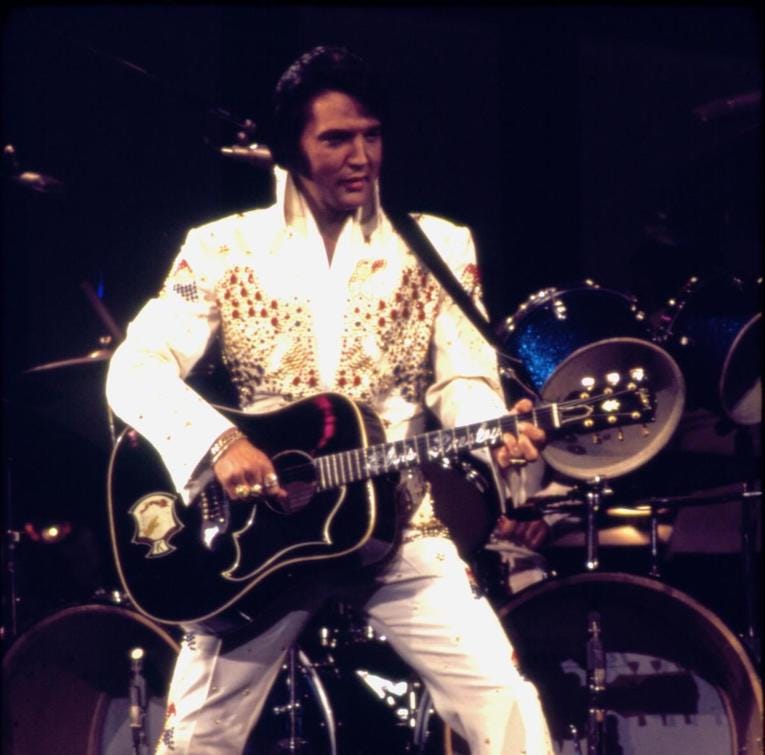
Elvis’s Vegas info and overall background from this section were mainly obtained from Peter Guralnick’s Careless Love: The Unmaking of Elvis Presley. New York: Little, Brown and Company, 1999
Details about this meeting, unless otherwise noted, come from Tony Joe White’s interview with Chris Shifflett on the Walking the Floor Podcast, Episode 114 (April 30, 2018).
Campion, Chris. “Tony Joe White: Audience With The Other Elvis”. Daily Telegraph (2006).