

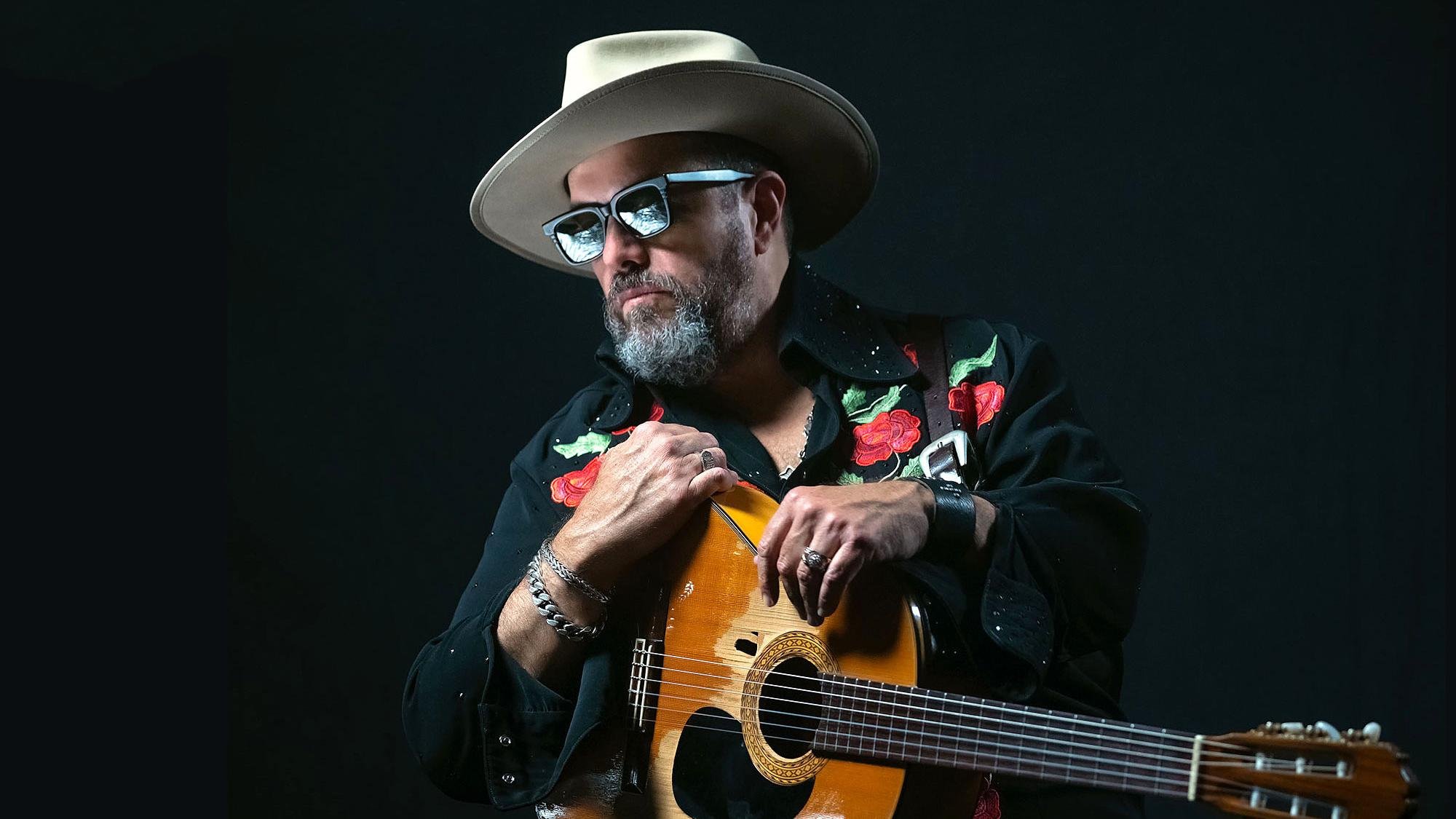
Some country radio listeners in the early to mid-1990s may have been able to differentiate between the sudden influx of new male country hat acts (an inordinate amount of whom were named Tracy for some reason), but for many, they were varying degrees of the same nasal twang. Meanwhile, the 1992 Mavericks album, From Hell to Paradise, provided one of the most distinctive voices ever to grace the country airwaves, that of lead vocalist Raul Malo.
A first-generation American, Raul Francisco Martínez-Malo Jr, was born in Miami to parents who’d emigrated from Cuba. He’d formed the Mavericks in 1989 with drummer Paul Deakin, bassist Robert Reynolds, and guitarist Ben Peeler. While they were led by a voice that was downright Orbisonian, what also made The Mavericks stand out on country radio was their genre-bending sense of adventure underscored by immaculate taste. A sound that could channel the best of traditional country, honky-tonk, early rock’n’roll, jangle pop, Tex-Mex, Cajun, Latin, and swamp pop, The Mavericks gave us a melting pot of roots music funneled through a strong pop sensibility with every release.
Their first charting single was a spirited, souped-up cover of the Hank Williams standard, “Hey, Good Lookin’,” a gutsy move that endeared me to them right out of the gate. Programming a small town AM country station at the time, I added the single, and although I always considered it one of Hank’s most overplayed, yet weakest songs, I was impressed by the fresh energy they gave it. Even on this well-worn warhorse, Malo’s vocals and performance demanded your full attention. It peaked at 74 on the Billboard country singles chart in late spring of 1992 and was included on their second album—and major label debut—From Hell to Paradise. Their previous, self-titled debut, had been independently released two years earlier.1
By 1994, they hit it big with What a Crying Shame. Several singles were released over the course of the album’s run, and they hit the top 40 with four of them, causing the album to go platinum within a year. One of its singles was a cover of Bruce Springsteen’s Tunnel of Love track, “All That Heaven Will Allow.” The nominations and awards started to trickle in.
After some artists get just a tiny taste of success, they try to play it safe, not wanting to rock the boat of a winning formula. With each subsequent album, however, The Mavericks got even bolder and more adventurous. They leaned into the Tex-Mex thing with a track from their next album, Music for All Occasions, “All You Ever Do is Bring Me Down,” a collab with Tejano legend—and Texas Tornado—Flaco Jiménez. It resulted in both the Mavericks’ and Jiménez’s highest-charting country single.
While Malo wrote most of the band’s material over the course of their career, he also collaborated on occasion with top songwriters from Radney Foster and NRBQ’s Al Anderson to prolific country hitmaker Kostas. The Mavericks’ songs didn’t reach the top of the charts the way the singles from Brooks & Dunn, Garth Brooks, Shania Twain, or Tim McGraw did, but the quality was always there, as well as a devotion to sturdy, roots-based sonic textures. With Malo steering the ship, even the relatively sad songs (“Here Comes the Rain”, “Foolish Heart”) carried an underlying sense of the joy of expressing oneself through music.
Malo had a smile that could brighten the room or anyone’s day. The band as a whole were utterly incapable of pretension. Their shows were a non-stop celebration. They contributed songs to the soundtracks of big films, from Apollo 13 (their take on “Blue Moon”) to the John Travolta angel flick, Michael (“I Don’t Care if You Love Me Anymore”).
Trampoline followed in 1998, powered by the ebullient “Dance the Night Away,” a track that didn’t make any impact on country radio, except in my little corner of the AM dial, where I had it in as heavy a rotation as I could.
In 2001, Malo released his first solo LP, Today. On it, he dove headfirst into his Cuban roots while exploring Latin rhythms and many other forms.
Three years later, he released The Nashville Acoustic Sessions, which included covers of songs by Bob Dylan, Willie Nelson, Gordon Lightfoot, Jimmie Rodgers, and, yes, Roy Orbison.
Over the next 20 years, releases would alternate between Malo’s solo work (which would usually involve casual, laid-back, yet passionate recordings of carefully chosen covers) and albums by The Mavericks. Brand New Day was a particularly inspired set of songs in 2017, followed by one of the best holiday albums of the 21st century, 2018’s Hey! Merry Christmas.
In 2020, they recorded their first album in Spanish. Here’s my review of The Mavericks en Español for No Depression.

Moon & Stars followed in 2024, and included a Malo co-write with the always great KT Oslin2 years before called “Live Close By, Visit Often.” Oslin had included it on her album of the same name in 2001. It was, well, a thrill to hear Raul put his spin on it (with Nicole Atkins helping out).
Just a month after the album’s release, Malo announced that he had been diagnosed with intestinal cancer. The band cancelled many of their shows for the remainder of the year as he underwent treatment. As everyone prayed and gave best wishes for the best of outcomes, the news only got worse. By late summer of this year, it was revealed that the cancer had spread to his spinal cord and brain.
On the weekend of December 5th and 6th, “Dance the Night Away: A 35 Year Musical Legacy Celebration Honoring Raul Malo” was put together at the Mother Church of Country Music, the Ryman Auditorium, and featured guests from Steve Earle and Marty Stuart to Maggie Rose and Jamey Johnson. Malo was unable to attend, but he shared a statement especially for the event:
I’ve always believed that music is one of the most powerful bridges we have. It crosses cultures, politics, (and God, don’t we need that right now?) languages, and sometimes pain. In these past months, I’ve had to fight battles I’ve never imagined. But on the hardest of days, music remained my companion. Your letters, your stories of how a song helped you through loss, heartbreak, joy, those became our songs. You all carried me more than you know. To my family band, the National Music Council, my musical collaborators, and every fan around the world: Thank you for giving my voice a place to live, even when my body cannot be the one delivering it. I accept this award with profound gratitude and with the hope that the music we create continues to inspire, to heal and bring people together.
On December 8, Raul Malo passed away, leaving us with memories of not only that incomparable voice, but the warmth, joy, and wondrous smile of a big-hearted, beautiful man. A statement on The Mavericks’ official socials read in part:
Anyone with the pleasure of being in Raul’s orbit knew that he was a force of human nature, with an infectious energy. Over a career of more than three decades entertaining millions around the globe, his towering creative contributions and unrivaled, generational talent created the kind of multicultural American music reaching far beyond America itself…
Though his earthly body may have passed, Raul’s spirit will live on forever in heaven, and here on earth through the music, joy, and light he brought forth. His contributions to American and Latin music will be everlasting, as his songs and voice touched fans and fellow artists around the world.
Malo’s presence elevated everyone he came in contact with. He went out of his way to help promote new, deserving talent. We won’t see his kind again, but I believe this old world would be a lot better if we’d all take just a little of his kindness and love and help spread it around just as he did, and as his music will continue to do, for decades to come.
Now, how’s about a little Tiny Desk action from happier times, followed by a Mixtape of some kickass Mavericks and Malo tunes to help us dance the night away…
Find the Apple Music Mavericks/Malo Mixtape here.
…and one more for the road, ‘cause why not?
Peeler left after the first album, making way for guitarist David Lee Holt, who joined for their second album, only to depart and form the Texas blues-rock powerhouse Storyville with guitarist David Grissom, vocalist Malford Milligan, and Stevie Ray Vaughan’s rhythm section, Chris Layton and Tommy Shannon, better known as Double Trouble. I’ll do a post on those guys one day. Stay tuned.
Yes, there will be a piece coming soon about KT Oslin, too.
Fantastic tribute piece Michael. Bravo. He was a treasure.
Hearing Raul sing “The Air That I Breathe” changed my life …