

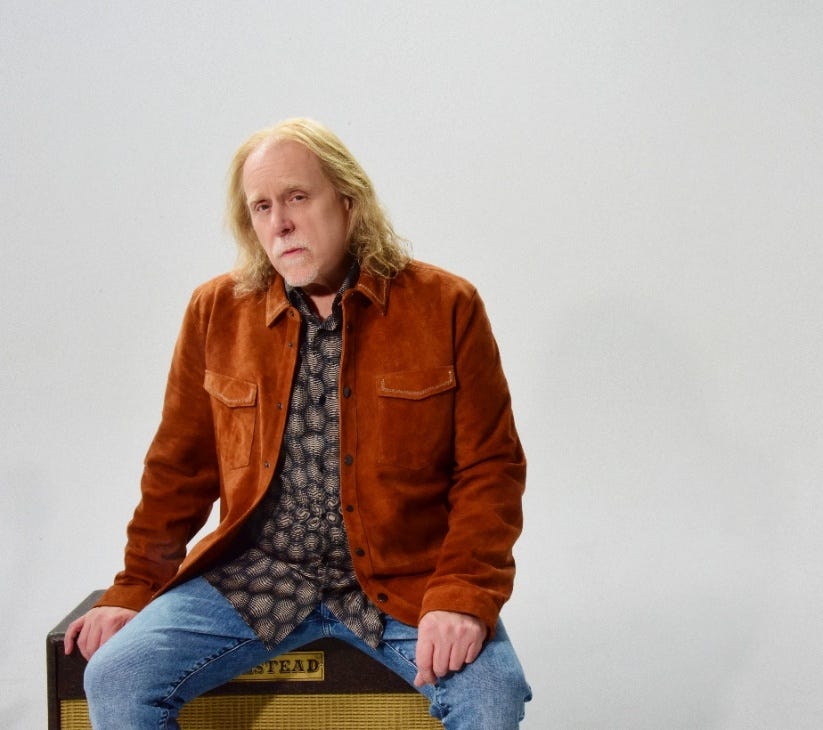
Back in 2011, Warren Haynes released his second solo album, Man in Motion. It’s a title he’s lived up to as a veteran of the road and the studio for well over 40 years, both solo and in groups such as the Allman Brothers Band, Gov’t Mule, Phil Lesh and Friends, and The Dead. Haynes has also shared stages with many of the most legendary names in music, toured with a jazz legend, played with a Reverend, and for a US President. Now, with 2026 well underway, he’s still on the move.
Since the last time we talked, in November of 2024, Haynes released the acclaimed Million Voices Whisper. That was followed in September of last year by The Whisper Sessions, a digital-only, stripped-down take on those same songs, plus covers of the Allman Brothers Band’s “Melissa” (with Derek Trucks on slide) and the Tammy Wynette classic “‘Til I Can Make It On My Own.”
On November 22 and 23, in response to the devastation in Florida and Western North Carolina (which included his hometown of Asheville)—caused by Hurricanes Milton and Helene, respectively—Haynes helped organize a benefit concert at Madison Square Garden dubbed “Soulshine: A Benefit for Hurricane Relief and Recovery.” Including appearances by the Dave Matthews Band, Goose, Nathaniel Ratliff & the Night Sweats, Mavis Staples, Susan Tedeschi, Derek Trucks, and others, the event raised around $4.5 million for those affected.1
Due to the devastation in Western NC, Haynes’s Annual Christmas Jam—which raises money each year for the Asheville Area Habitat for Humanity and BeLoved Asheville—was cancelled for December of 2024, but returned in full force the following year for its 33rd installment, featuring appearences by Stone Temple Pilots, MJ Lenderman, Daniel Donato, Maggie Rose, Edwin McCain, and others.
Now, Haynes is kicking off 2026 by looking back. He’s reissuing his 1993 solo debut, Tales of Ordinary Madness, on the mighty Megaforce Records.

By 1993, Haynes was four years and two albums into his tenure with the Allman Brothers Band. He was still a year away from forming Gov’t Mule with bassist Allen Woody and drummer Matt Abts, but he was armed with a handful of demos that he was ready to make into an album. Along with longtime ABB extended family member, Chuck Leavell, Haynes co-produced what became Tales of Ordinary Madness (the title inspired by a book of short stories by Charles Bukowski).
Madness came out at a time when Southern Rock as a (sub)genre was experiencing something of a comeback, as the likes of the Black Crowes (for whom Leavell had played on their 1990 debut, Shake Your Money Maker) and a handful of others south of the Mason-Dixon were making an impact on rock radio and the charts. Much of Madness rocked hard, tempered with complex arrangements that kept you engaged, while Haynes got a chance to shine as a lyricist and vocalist in addition to his already acknowledged guitar prowess. Leadoff track, “Fire in the Kitchen,” set the tone for most everything that followed.
It wasn’t all hard’n’heavy, however. “Blue Radio” is atmospheric blues and soul that never fails to captivate, while decades later, “I’ll Be the One” still sounds like a great lost hit single and stands as one of Haynes’s greatest vocal performances; an aching, pleading love song for the ages.
Overall, Tales of Ordinary Madness acted as a perfect primer for what lay ahead for Haynes—and his fans—for the next 30-plus years.
I spoke with Haynes and Chuck Leavell about what it was like going back to Madness, as well as Haynes’s upcoming solo tour, working with Billy Bob Thornton on a new song for Landman, and what’s going on in the world of Gov’t Mule. But first, we discussed his recent appearance on The Late Show with Stephen Colbert.
What was it like playing with the Late Show band last week, and how did that come about?
WH: Fun, you know, it just came about organically. I’ve been friends with Louis Cato for quite a few years, and we ran into each other at his Soho Sessions benefit show. And he said something to me about coming down to sit in with those guys before they ended their tenure, so to speak. And it turned into me saying, ‘Why don’t you come join us on New Year’s Eve?’ So [Cato] came down and joined Gov’t Mule for three songs during our New Year’s Eve set, and then I went and joined him for [Colbert]. It was fun. That’s a great band.
You guys did “Life As We Know It” [from Million Voices Whisper]. How much rehearsal was needed?
WH: Not a bunch, really. They learned it in advance. We ran through it once at rehearsal that afternoon, and it sounded great.
What was the idea behind reissuing your first solo album, Tales of Ordinary Madness, now?
WH: Well, I always wanted to remix that record because even though I was happy with it at the time, that was in a time period when the sonic approach to records was still a little held over from the late 80s / early 90s. They had a lot of reverb, EQ, and processing. A couple of years after I made that record, things went back to more like a ‘70s, organic approach, which has proven to be quite a timeless sound. So I always wanted to remix it with that in mind. Then, a year ago, or something, I ran into Missi Callazzo, who owns Megaforce Records now, and I brought that up to her, and she said, ‘Funny, you mentioned that. I’ve been thinking the same thing. Why don’t we remix it in honor of the 30th anniversary?’ And so we agreed on Jim Scott to remix it, and he did a fantastic job. This version sounds a little more like I envisioned it sounding.
When I first picked up the CD back in ‘93, I got a kick out of the fact that it was on Megaforce, the metal label that was home to Metallica, Anthrax, Testament, etc. How’d that relationship come to be?
WH: Well, they were looking to diversify, expand, and go in some non-metal directions. And I was a fan of some of the stuff they were doing, like King’s X. So, I met with them, and they were just very passionate and encouraging and supportive. It turned out to be the right thing.
How did Chuck Leavell get tapped to produce?
WH: When we were thinking about producers, we put a bunch of names in a hat. My manager at the time, Doc Field, knew him, and he had asked me, ‘What about Chuck?’
CL: Doc was a real sweet fella, and he told me, ‘I got this guy, he can do it all. He can write. He could sing….great guitar player.” And I said, ‘Okay, send me something.’ He sent me some demos. I think they were ‘Fire in the Kitchen’ and ‘Blue Radio.’ And I said, “Well, yeah, you’re right. He can do it all!’
WH: At that time, we didn’t know each other, but we were mutual fans, and we both had our relationship with the Allman Brothers music, and I thought, ‘Yeah, that would be a great idea.’ So, Doc set up a meeting, and, of course, we hit it off. Got along famously, and it just made sense. And Chuck is a fantastic musician.
CL: I was extremely impressed with what I heard, so I had a conversation with Warren. We talked about logistics and doing it in Atlanta, and talked about the musicians. He asked me, ‘Can you play on it?’ Yeah, I’ll play. I can co-produce and play. And so we put all that together, and Doc had done the deal. So we started the sessions, and everybody was well prepared. Warren was certainly very well prepared, you know? He had written the songs and had a good vision for what to do. And as we went through the process, each song kind of dictated the instrumentation, whether I would play on it or not, or whether I would do organ or piano or both. It was just a wonderful experience.
Tales of Ordinary Madness is populated with some major talent. How’d you recruit the musicians?
WH: Well, before I moved to New York, I had been doing all these demos with Michael Rhodes and Greg Morrow as the rhythm section. And Chuck Leavell was on a few of those as well. Then, when I moved to New York, I teamed up with Steve Holly and Lincoln Schleifer, and we were doing some gigs around the New York area. So, they learned all that material. I wanted to use both rhythm sections. It was really just a wish list for me, of all the people I’d like to be on my first record.
CL: I’ve been friends with Randall Bramblett for such a long time. He was in Sea Level with me, and I played on his first solo record going back to the early ‘70s. Greg Morrow had done a lot of work in Nashville and was very seasoned and very quick. And Michael Rhodes, oh, my God. He was a genius on the bass; such a sad thing that we don’t have him anymore. But he was a great contributor, and very seasoned, and, you know, helped to make things go quickly.
This reissue has added “Tear Me Down” to the tracklist. I remember seeing you, Warren, perform that song during the Man in Motion tour with the Warren Haynes Band. Why was it left off the original release?
WH: We were over budget and out of time, and we just weren’t able to finish it. Something had to go. So that wound up being the sacrificial lamb. It was always one of my favorite tracks, too. So I hated that we weren’t able to include it back then. So when I went in, before we did these remixes, I revisited and finalized it, and, man, it was just such a pleasure to hear all that stuff after all these years. And that one is one of my favorites on the record. That’s Randall Bramblett [Sea Level, Traffic] on saxophone and Bernie Worrell [Parliament-Funkadelic] on clavinet.
Warren, you’ve got a new song on the latest soundtrack for Landman, co-written with Billy Bob Thornton and Mark Collie. How did that come about?
WH: Well, Billy and I’ve been friends for a long time. You know, he appeared on “The River Only Flows One Way” as a kind of spoken word vocal performance on the last Gov’t Mule record [Peace…Like a River]. We’ve written a couple of songs together over the years, and he called me recently and said that he and Mark Collie were working on this song, “Desiree,” and wanted to get me involved with it. So, they sent it to me, and I was really happy with what they had. I added my own thing to it, and it wound up being part of this soundtrack.
You’ve got a solo tour coming up this year. When was the last time you went on a multi-date tour just by yourself?
WH: Well, I’ve never done a real tour that way. I did a handful of dates strung together years ago, but it’s been a long, long time. Usually, I just do one or two or three. I’ve always wanted to do an actual tour. For whatever reason, it took until now to do that.
Was the decision for the solo tour inspired by last year’s Whisper Sessions?
WH: Yeah, that was probably part of the inspiration for it.
Turning to Gov’t Mule, you’re heading out with them this year as well. [Drummer] Matt Abts had to sit out some shows recently. How’s he doing?
WH: Matt’s doing okay, though he’s been having issues with his back. He chalks it up to 60-something years of playing drums.
The Mule just celebrated their 30th anniversary in 2025. The last time we talked, there were plans to reissue the first album with a bonus disc. How’s that coming?
WH: It’s ready to go, and the bonus disc is amazing. It’s about 80 minutes of unreleased outtakes, mostly from the first album sessions, but a couple of other things as well; all that stuff with the original trio with Alan Woody. Hearing that stuff—going back into the vault, and checking all that stuff out—it’s really cool that we have that stuff to release. I’m really psyched about that.
Any new Mule on the horizon?
WH: As far as getting back in the studio, I’m really excited to do a Mule record with [new bass player] Kevin Scott, which we haven’t done yet. But, I’m not sure what the next studio project is going to be.
When you listen back now to Tales of Ordinary Madness as well as that first Mule album, how have you changed from the guy who wrote and performed those songs over 30 years ago?
WH: Well, it’s kind of hard to pinpoint that. Obviously, my songwriting has gone in a dozen different directions since then. As a singer and as a player, all that has changed. My approach is kind of a gradual, unspoken sort of thing. When I go back and hear myself, I’m surprised how much things have changed, but I’m really proud of those records.
Chuck, at the time, you were also working with Eric Clapton and the Rolling Stones. Looking back, what was working on Madness like for you?
CL: It was just such a great opportunity. I was wanting to get more into production at the time, and Warren was very gracious to agree to have me on board. You know, I wish my producing career could have gone a little stronger after that. But of course, I’m very grateful that I wound up with all the work before and after; everybody from the Stones and Clapton, to George Harrison and others that I’ve had the privilege to work with, but it was just a wonderful opportunity. I was very grateful for it, and very grateful for the effort that everybody put into it.
Warren, back then, were you looking ahead to the future, or just living for the day? I guess I’m asking: 30 years on, have you accomplished all you’ve hoped to achieve?
WH: As far as a list of what I haven’t done yet, one of those things would be an instrumental, jazz-influenced record. I still haven’t done that. I’m not sure what’s going to happen next, but that’s a possibility. Up until we did Heavy Load Blues, a blues record was on that list, but we checked that off. You know, you can never predict how things will go, but I’ve been very happy with the trajectory my career has taken.
Upcoming tour dates and tickets available at warrenhaynes.net and www.mule.net.
Order/stream Tales of Ordinary Madness here.
Further Reading on Warren Haynes, Gov’t Mule, and the Allman Brothers Band:
For No Depression:
Warren Haynes Talks New Solo Album, Gov’t Mule’s 30th, and the Allman Brothers’ Final Show
Gov’t Mule Honors Influences With Their Own Twist
For PopMatters:
Gov’t Mule’s ‘Heavy Load’ Will Lighten Your Burden
For Albumism:
The Allman Brothers Band’s ‘Seven Turns’ Turns 35
Gov’t Mule’s Eponymous Debut Album ‘Gov’t Mule’ Turns 30
For The Mixtape:
The Allman Brothers Band: 30 Years Back to Where It All Begins
A Second Helping of Southern Rock, Part 2 of 2
More Mixtape Conversations:


https://kslx.com/all-star-soulshine-concert-raises-4-5-million-for-hurricane-relief-efforts
Awesome interview, Michael! Warren is the king 🤘 great read