

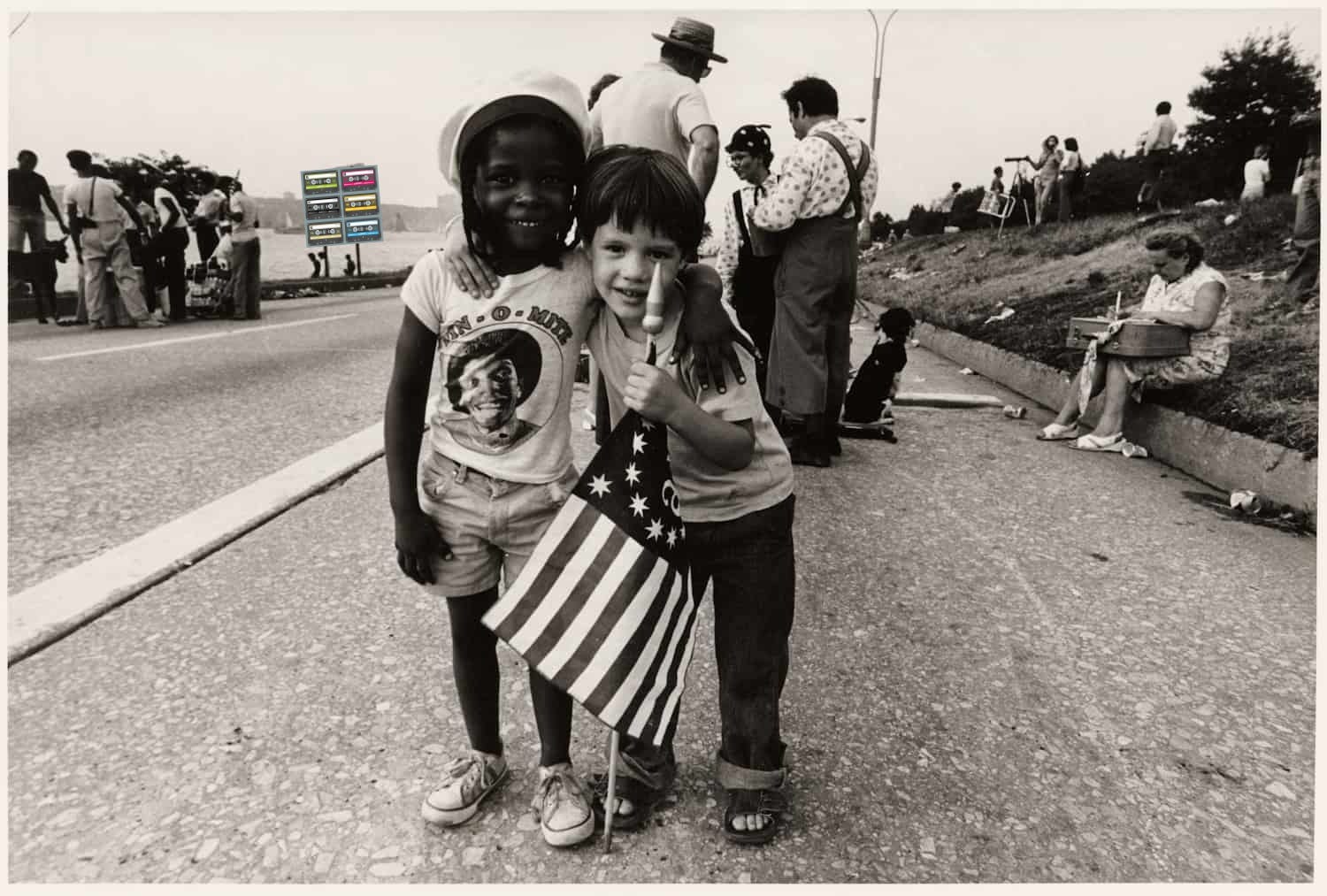
America celebrated its 200th birthday less than two years after Richard M. Nixon became the first US president to resign from office.1 Just one month after his resignation speech to the nation, his successor, President Gerald R. Ford (who had been nominated to replace Vice President Spiro Agnew after Agnew resigned in October of 1973 stemming from entirely different shenanigans than Nixon’s2), issued “a full, free, and absolute pardon unto Richard Nixon for all offenses against the United States which he, Richard Nixon, has committed or may have committed.”3 1976 was an election year, and Ford ultimately found himself running against a peanut farmer from Plains, Georgia, Jimmy Carter, who also happened to have the power of rock’n’roll on his side.4
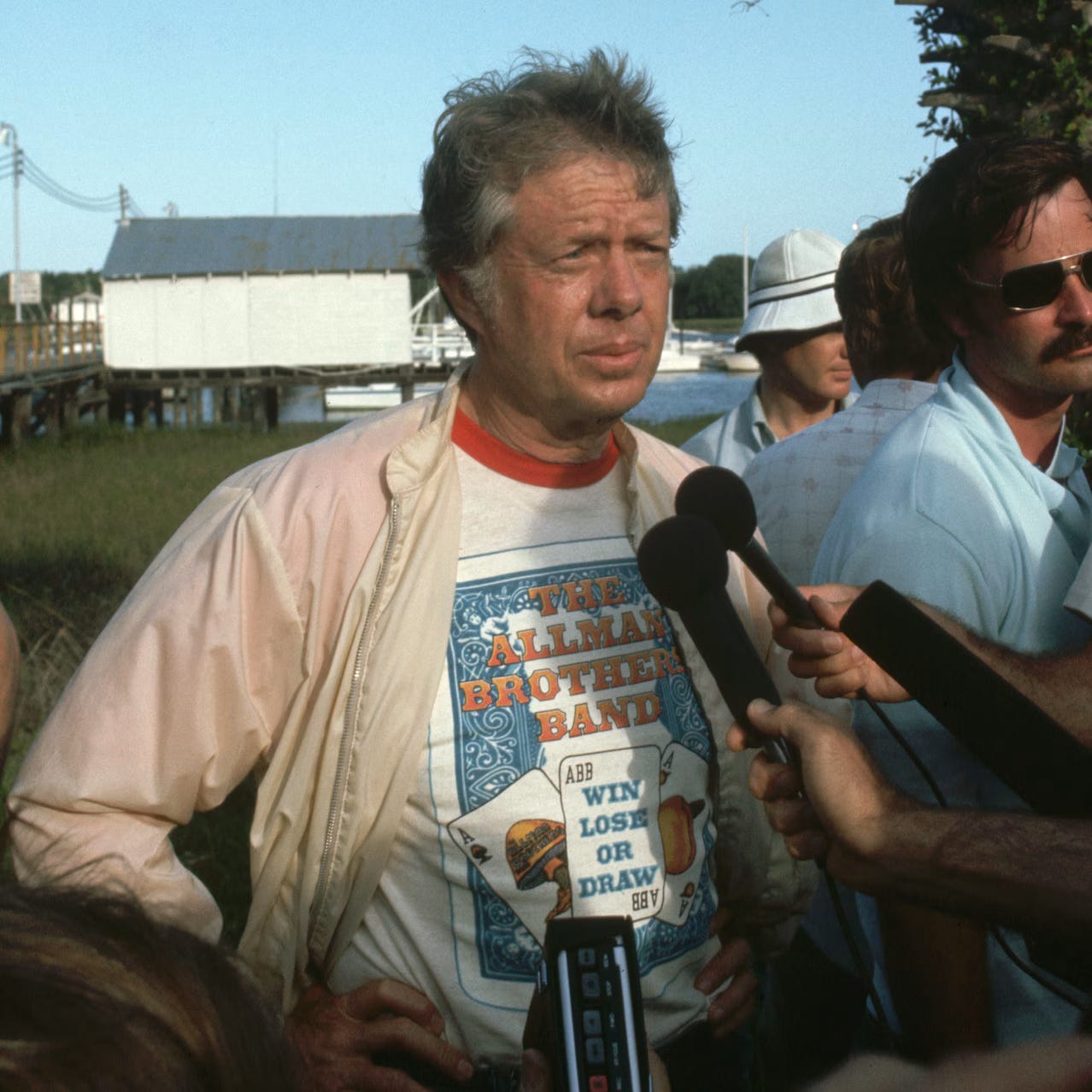
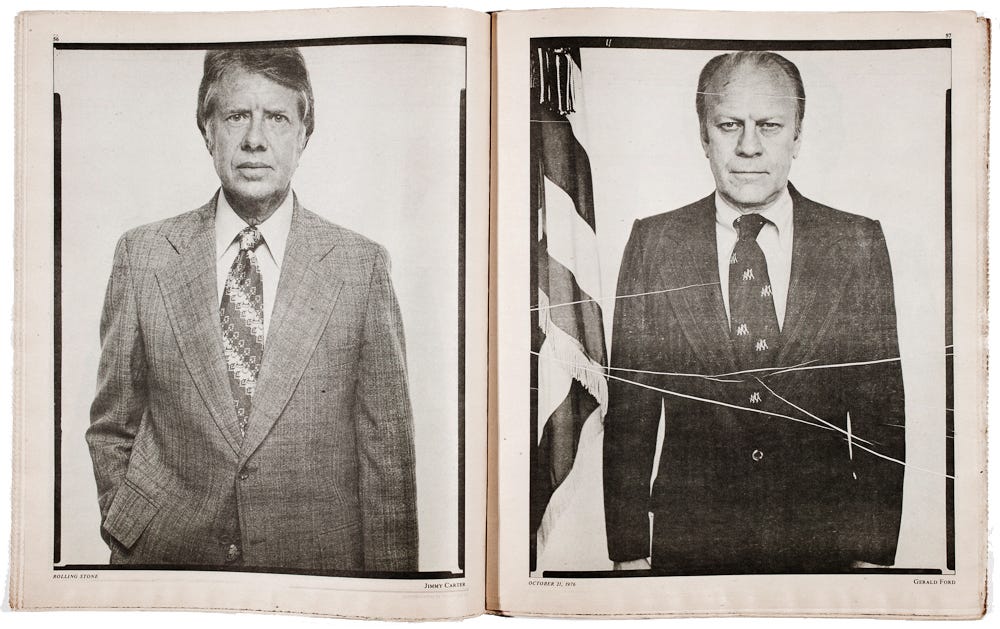
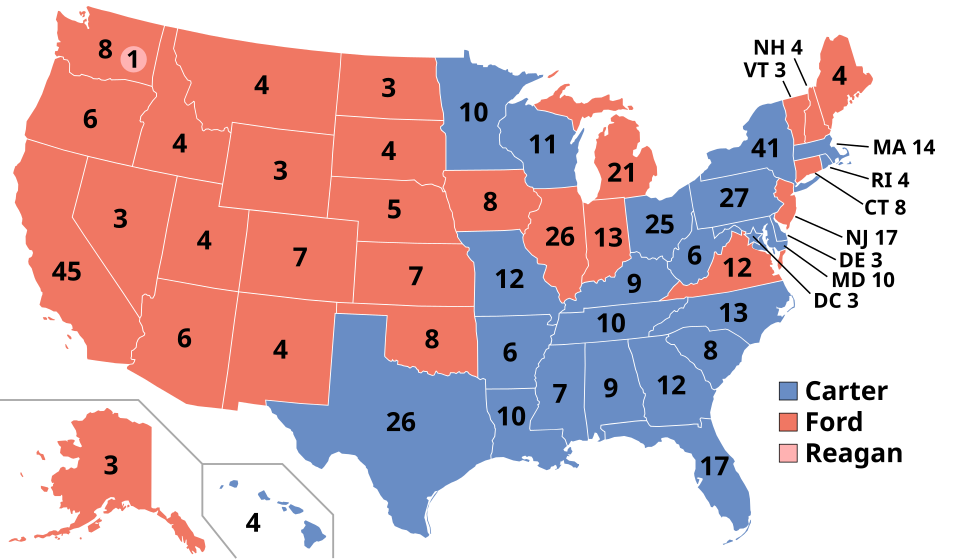
Carter ultimately won in a close election in November by securing 297 electoral votes to Ford’s 240. Carter also won 50.1% of the popular vote and carried every state in the South but one. (Only Virginia went for Ford.)
The Bicentennial
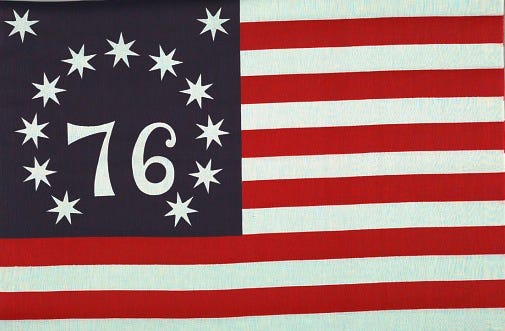
Congress began planning the US Bicentennial ten years earlier when it formed the American Revolution Bicentennial Commission on July 4, 1966. Congress, being Congress, however, dissolved the commission in 1973 and instead formed the American Revolution Bicentennial Administration. (I’m not making this up.)5 Everything was re-imaged into red, white, and blue. Even the World Book Encyclopedias my family swore upon issued a Bicentennial edition.6
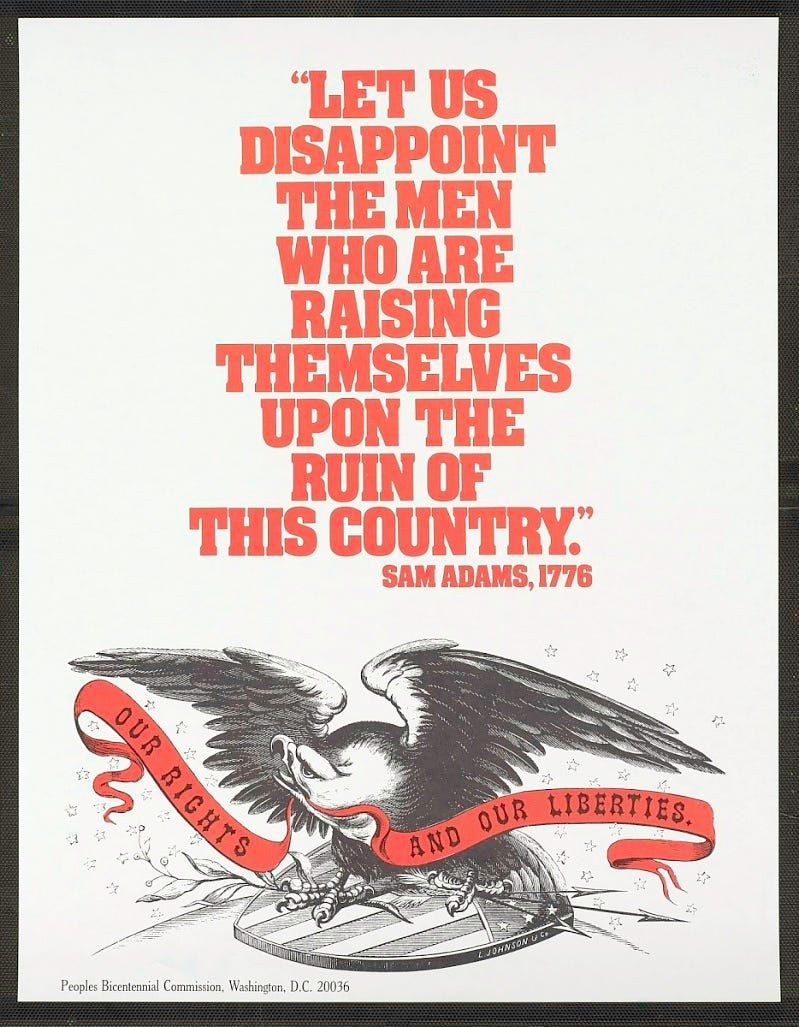
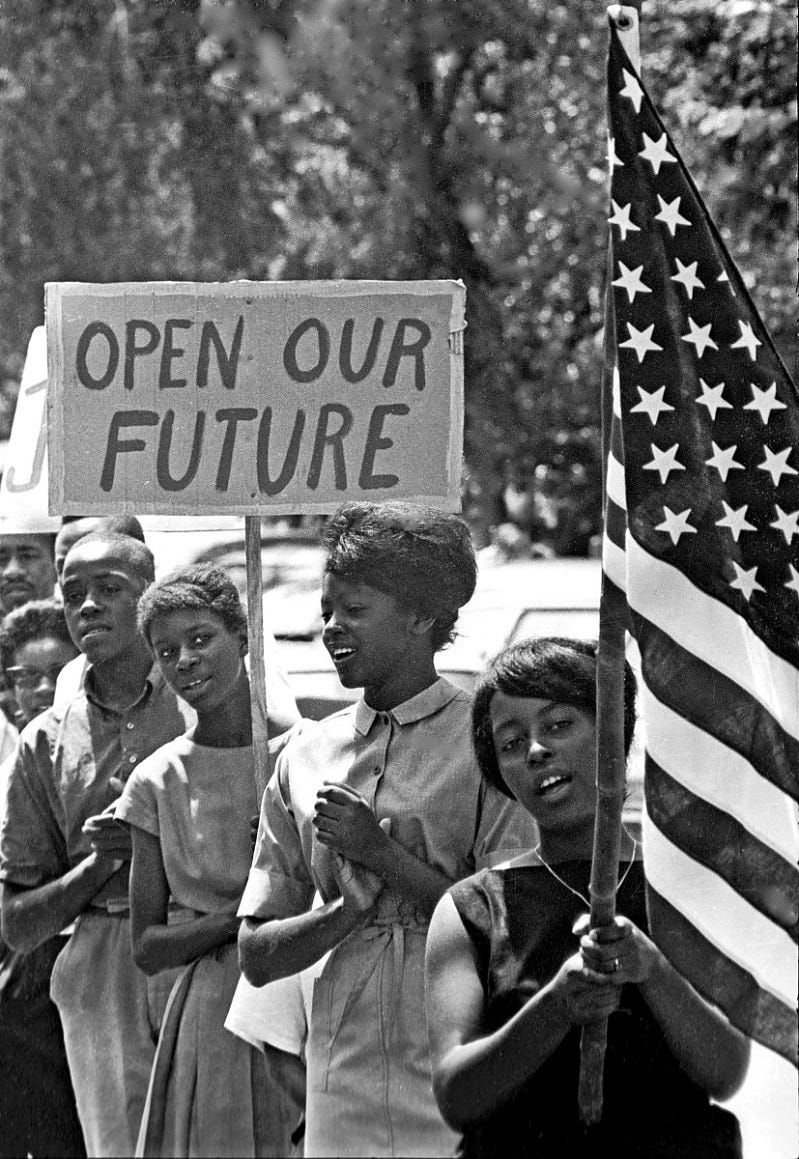
National pride ran rampant throughout the country with parades and celebrations. For a moment, the Bicentennial served to remind us, especially after Nixon’s resignation in ‘74 and the end of the war in Vietnam the following year, what our country, although imperfect, originally stood for.
TV and Film
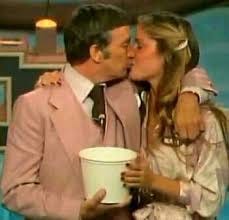
On the small screen, Family Feud debuted with horny host—and former Hogan’s Heroes star and Match Game regular—Richard Dawson, who kissed pretty much every woman square-ass on the lips.7
Alice also debuted (a TV adaptation of Martin Scorsese’s 1974 film, Alice Doesn’t Live Here Anymore); while What’s Happening shared the exploits of Rerun, Rog’, Dwayne, Shirley, and the rest of the gang; and Leonard Nimoy hosted one of the spookiest shows on TV that covered everything from ghosts and aliens to ESP and Bigfoot, In Search Of…
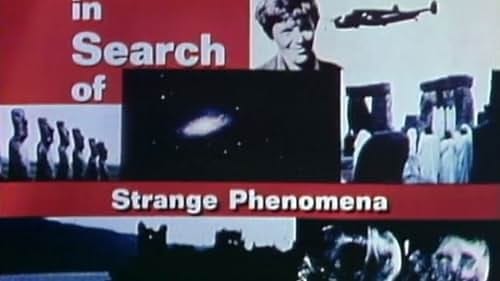
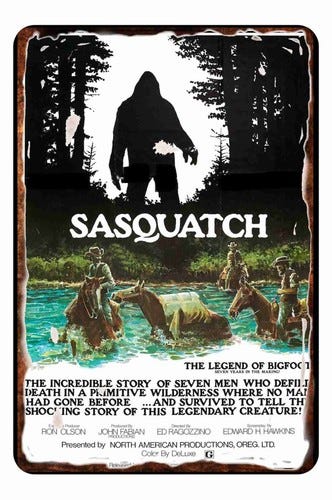
For some reason, Bigfoot was everywhere in 1976. From In Search Of and The Six Million Dollar Man8 to Sid and Marty Krofft. He even had his own movie, which, frankly, scared the hell out of me as a kid.
Speaking of the Kroffts, I was a big fan of Wonderbug…
Looking back now, man, that was some silly mess. But not as silly as this.
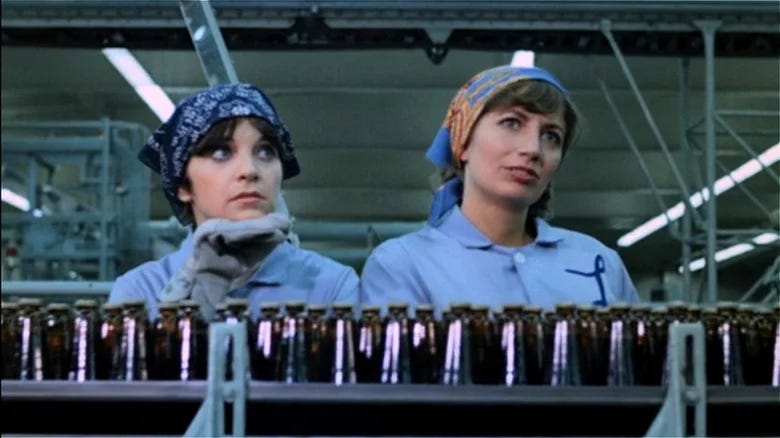
Also, from Happy Days, one of the first and most successful spinoffs in TV history debuted: Laverne & Shirley.
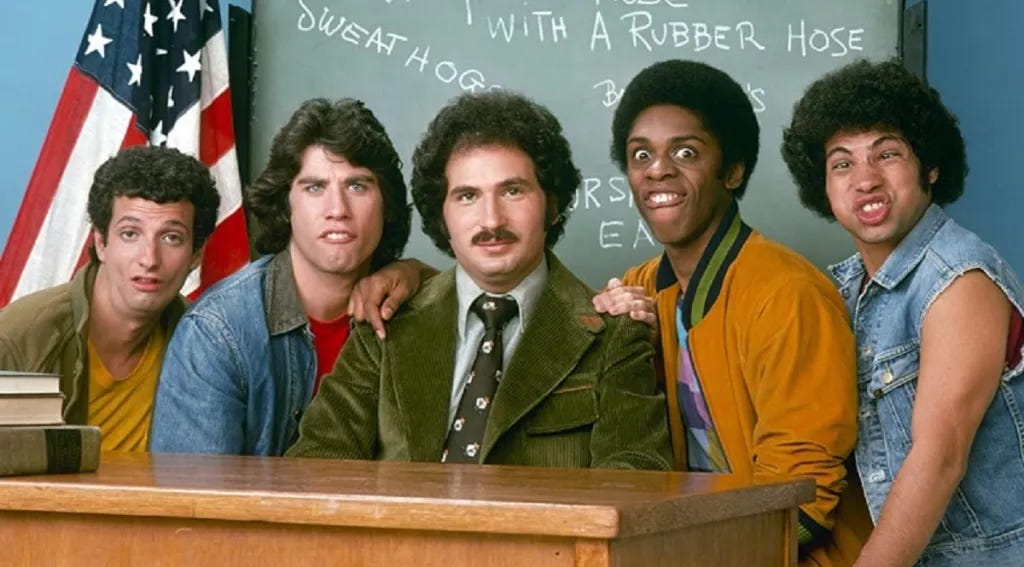
Although it premiered in the fall of the preceding year, 1976 is when Welcome Back, Kotter really started to hit its stride.
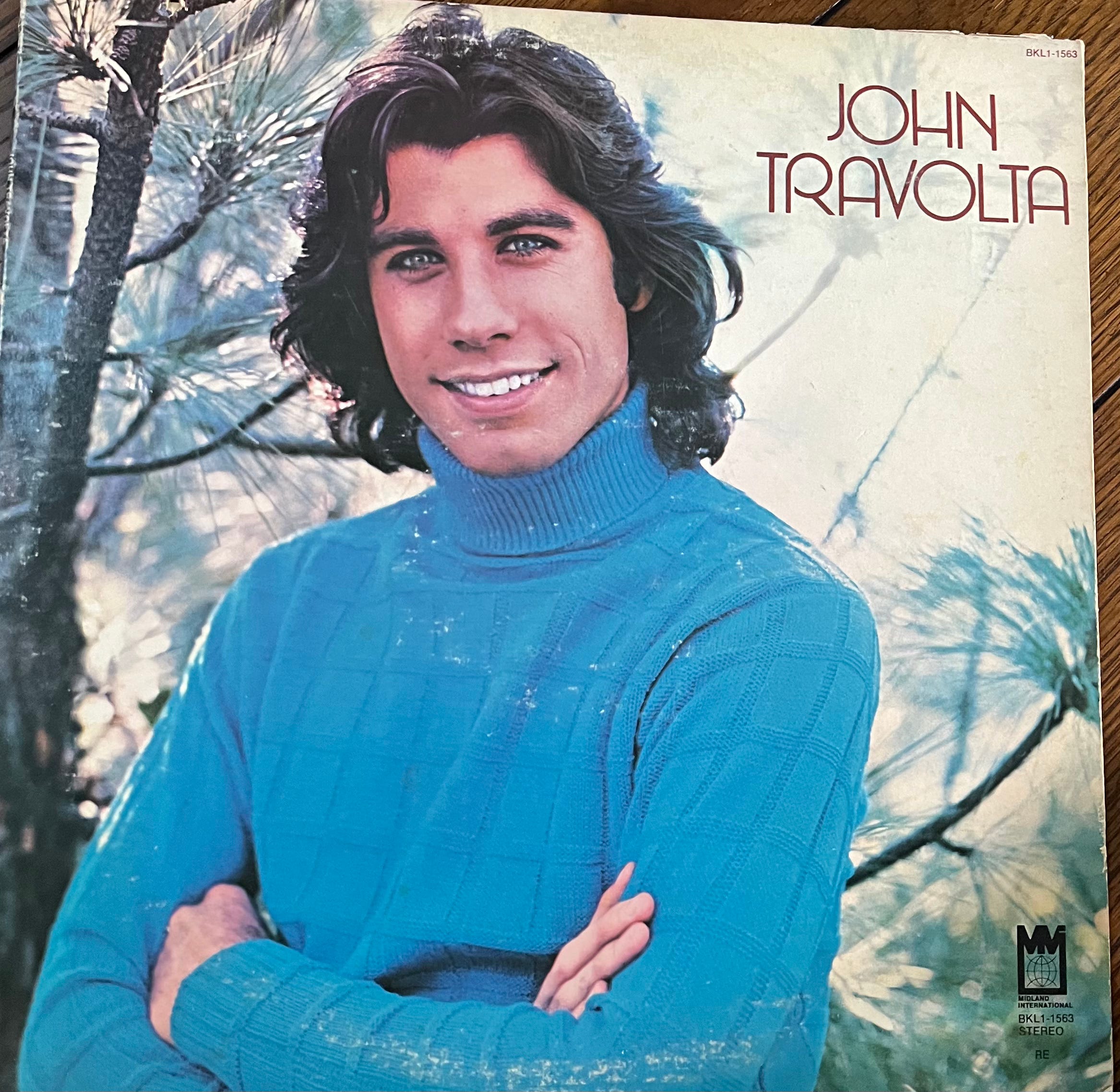
This was mainly due to its breakout star, who played Vinnie Barbarino, and really started to make his mark that year.
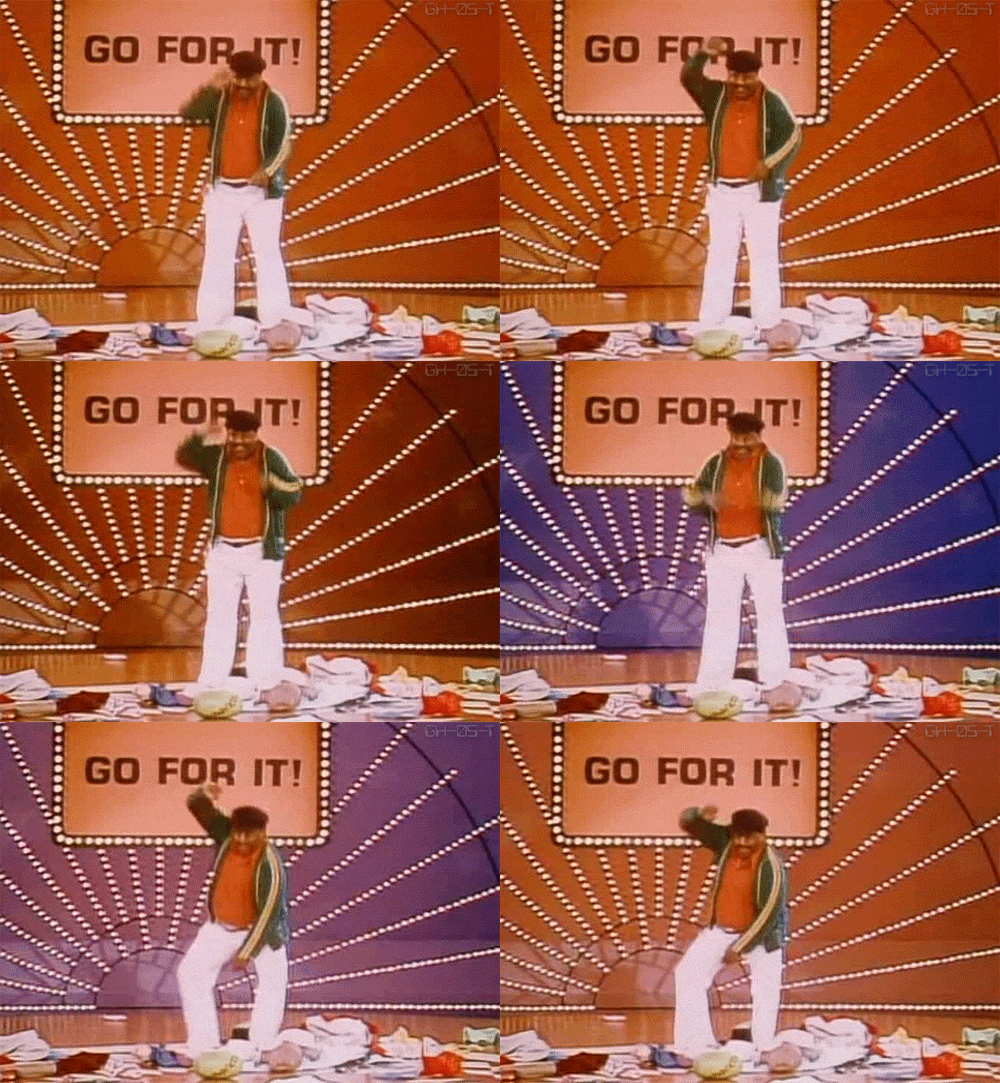
And we mustn’t forget, 1976 saw the debut of The Gong Show. Hosted by successful game show producer and CIA assassin9 Chuck Barris, the show featured a rotating panel of judges made up of TV stars of the day10 as they passed judgment on contestants and recurring regulars, like the Unknown Comic and Mean Gene, the Dancing Machine.
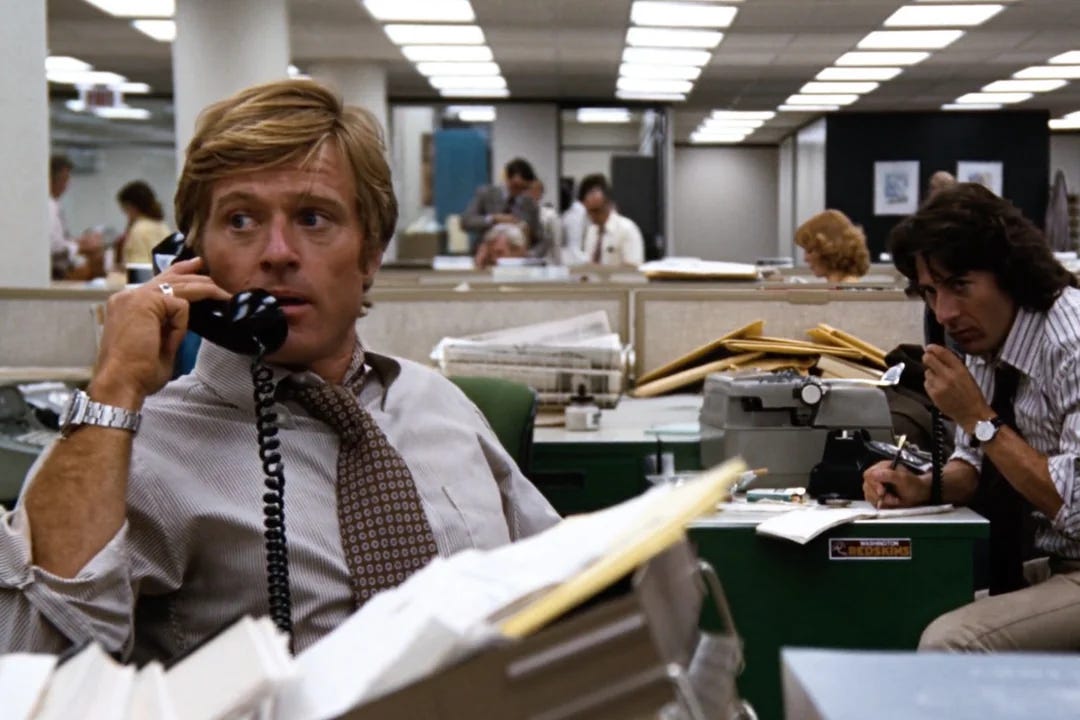
Meanwhile, on the big screen, with Watergate still very much in the public consciousness, Robert Redford and Dustin Hoffman starred as Washington Post reporters Bob Woodward and Carl Bernstein, respectively, in All the President’s Men. It was the glory days of newsrooms, manual typewriters, craggy editors, and Hal Holbrook creeping about in strategically-lit parking decks.
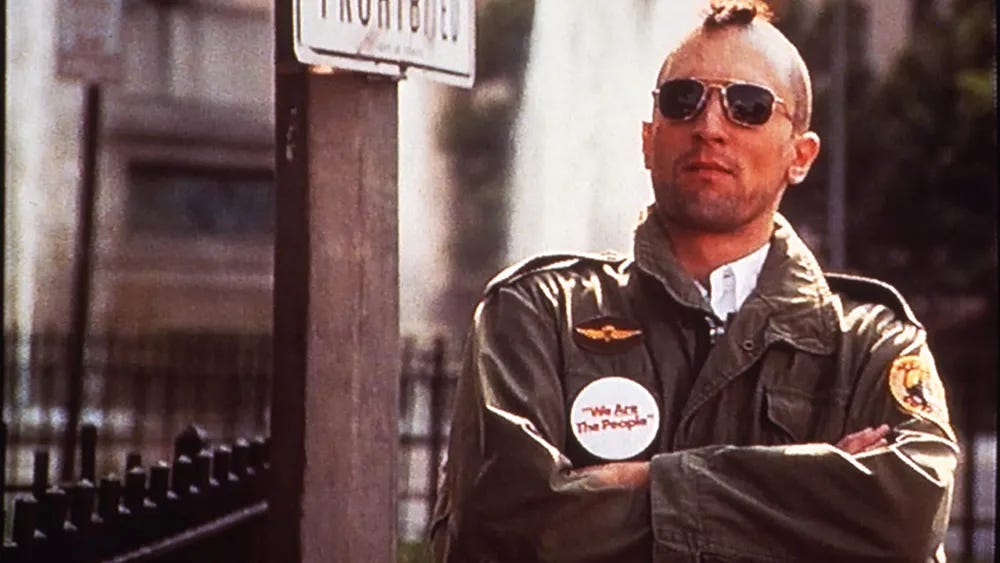
Scorsese, meanwhile, tapped into the male loneliness epidemic almost a half-century before it became a thing with Taxi Driver. Starring Robert De Niro as Travis Bickle and written by Paul Schrader, it’s still considered one of the best films of the decade, if not all time.
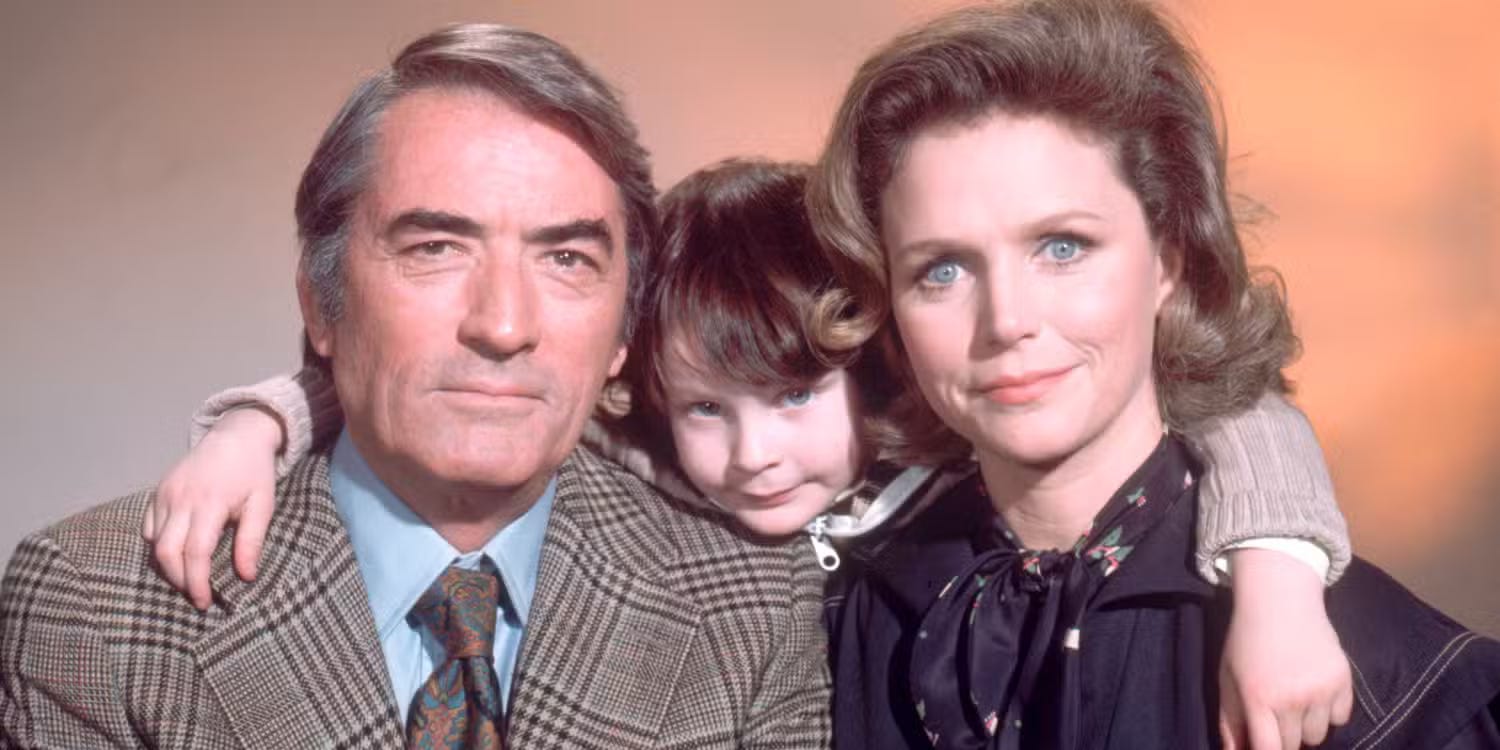
On the horror side of things, after the success of The Exorcist, everyone was still enthralled with all things Satan, so we were treated to Damien, the Antichrist, in The Omen, which—at the time, anyway—was considered a fictional tale.11
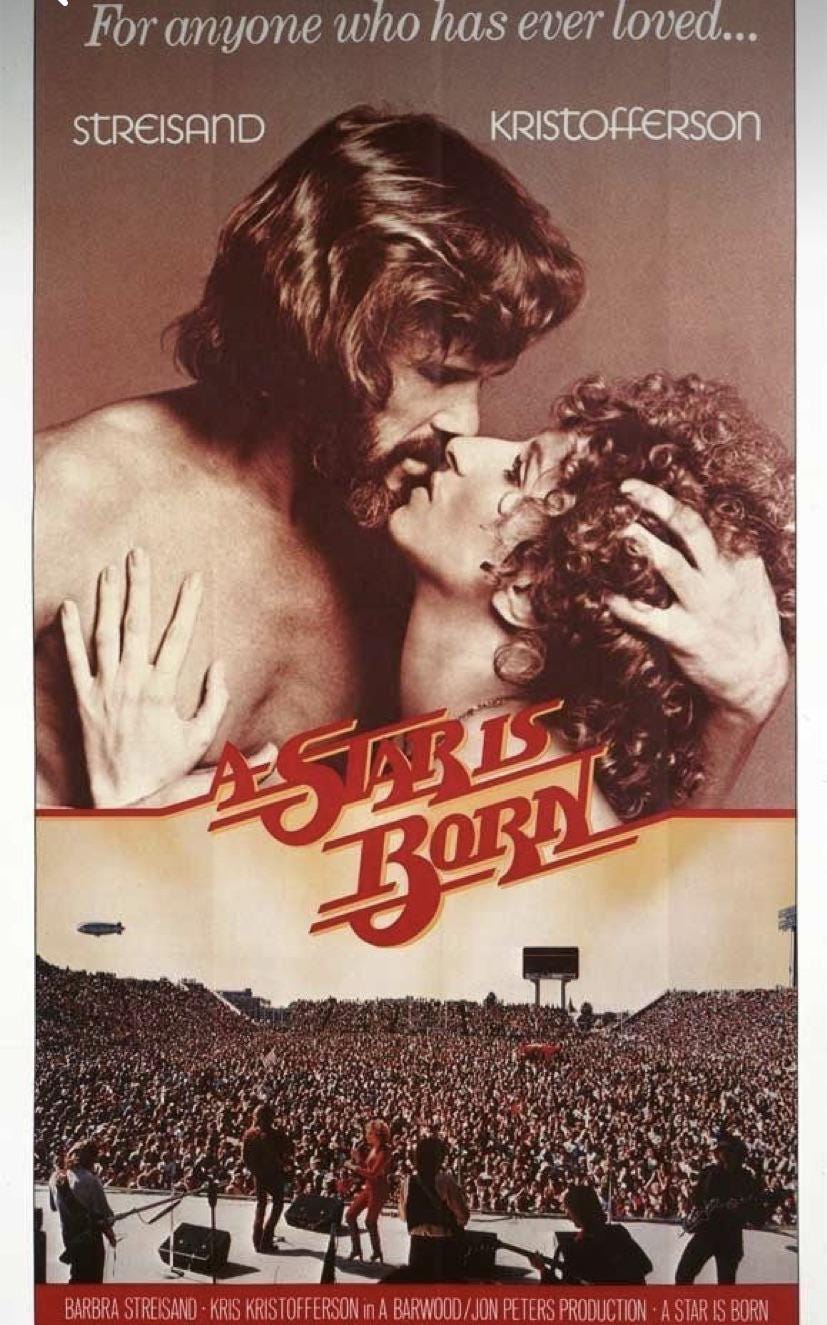
Then there were the musical tragedies. Barbra Streisand and Kris Kristofferson steamed up the big screen in a remake of A Star Is Born, a film that, by law, seems to get remade every couple of generations.
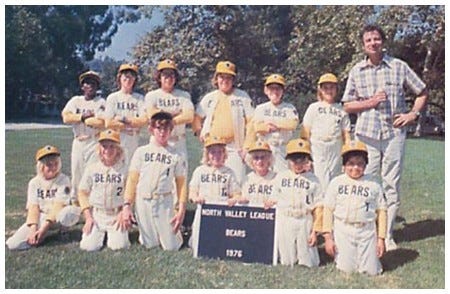
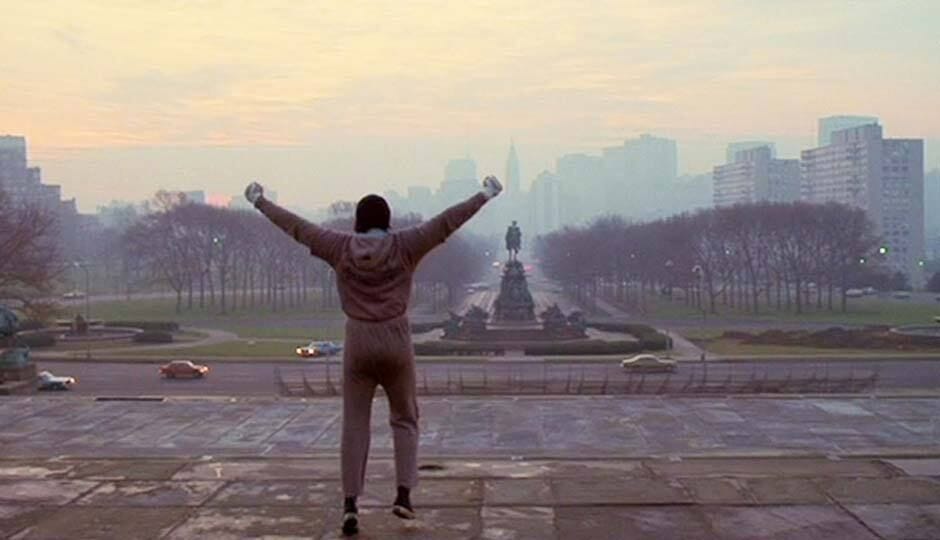
The movies in 1976 weren’t all dark and dramatic, however. It was also the year of Car Wash, The Bad News Bears, and, of course, the ultimate underdog tale, Rocky.
The Music
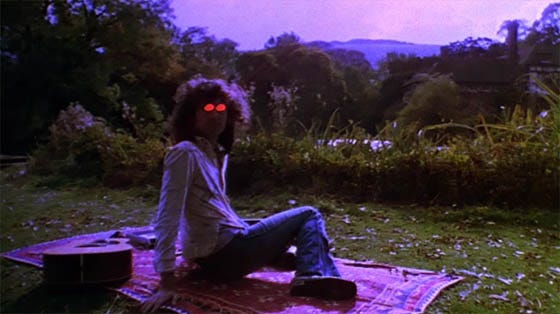
Musically, on the rock side, 1976 was the year of the live album, from Frampton Comes Alive!, Lynyrd Skynyrd’s One More From the Road, and Bob Seger’s Live Bullet, to the concert film and soundtrack of Led Zeppelin’s The Song Remains the Same. It was also the year punk broke, at least in the United States, with the earth-shattering debut album from The Ramones. Although singles such as The Damned's “New Rose” and the Sex Pistols’ “Anarchy in the UK” were released in the UK in ‘76, it’d be another year before their respective debut albums—along with the self-titled first by The Clash—would hit stores.
The two Johnnys—Ramone and Rotten—clashed with superstar acts such as the Eagles,12 who released what eventually became the best-selling album of all time, Their Greatest Hits: 1971-1975.1314 They followed it by adding Joe Walsh and releasing Hotel California by December. Mainstream rock still dominated as everyone from Led Zeppelin and Steely Dan to new artists such as Boston crowded the airwaves with huge, slick, flawless productions.
Punk wasn’t the only subversive style slowly gaining a foothold in the public consciousness and pushing against the status quo. Disco had worked its way up from the gay clubs and discotheques of Manhattan onto the national stage. Established artists began to incorporate those elements into their music. Hi-hats were opening and closing on the upbeat all over the radio. Bass lines were walking. Shirts were unbuttoned further, brazenly displaying coke spoon necklaces. Lapels were getting wider and more aggressive. It was apparent that, as The Meters put it, “Disco is the Thing Today,” when, in September, former WKIX DJ in Raleigh, NC (but at the time working for Memphis’s “The Great 68" WMPS-AM), Rick Dees released—and soon hit number one—with “Disco Duck.”15
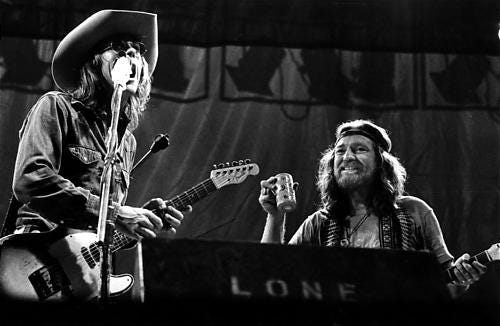
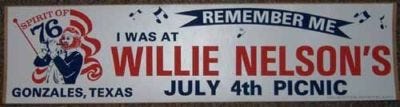
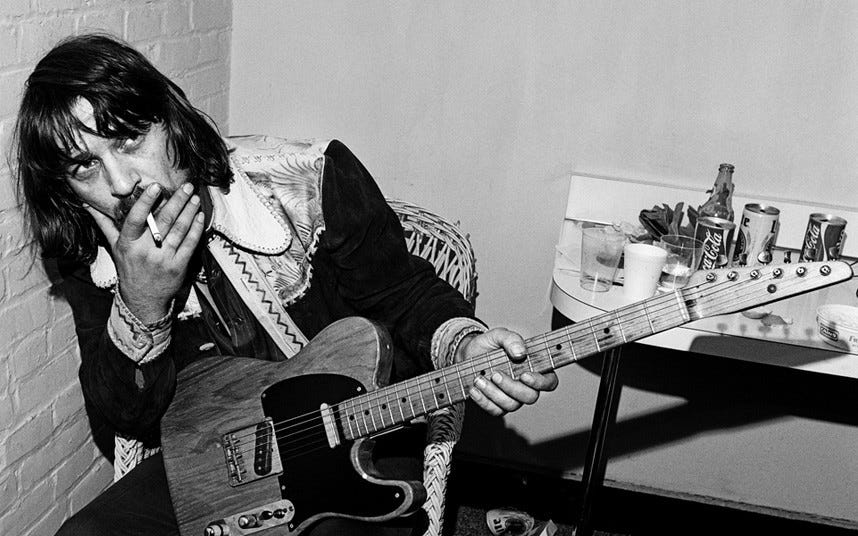
Meanwhile, in the world of country music, Willie, Waylon, and the boys (and girls) began making waves with their brand of country—the kind that got branded Outlaw—and became mainstream. In 1976 alone, in addition to the massive success of Wanted: The Outlaws (see below), both Willie Nelson (with The Sound in Your Mind and The Troublemaker) and Waylon Jennings (Are You Ready for the Country and Waylon Live) put out two albums each.
The Best of 1976
What follows are 25 albums plus 25 honorable mentions I either grew up with or discovered at various points over the last 50 years, followed by a Mixtape of 76 songs that pull from this list and 26 more albums and/or singles at least worth mentioning. If you don’t see a favorite, feel free to let me know in the comments.
Aerosmith - Rocks
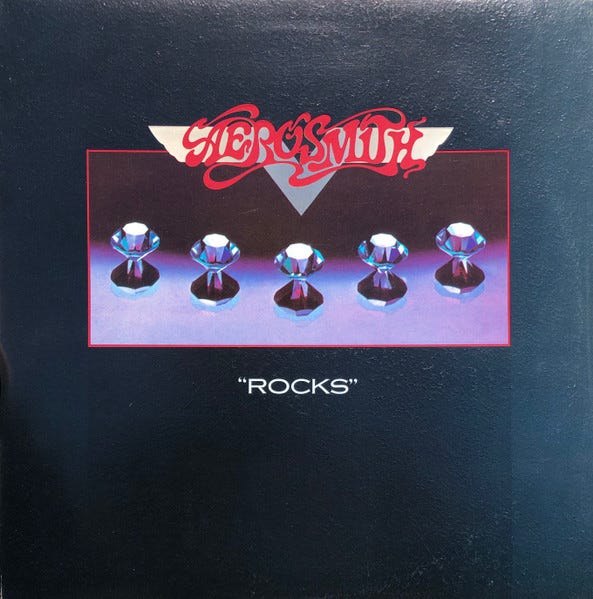
Aerosmith’s best album kicked off with a squalling statement-of-purpose western-themed rocker and picked up steam from there. Through the “punk in the street” ethos of “Last Child,” through the ominous heavy blues of “Combination” and “Nobody’s Fault,” to the classic swagger of “Get the Lead Out” and “Sick As A Dog,” Rocks found Boston’s bad boys at their undisputed baddest.
Bob Marley & the Wailers - Rastaman Vibration
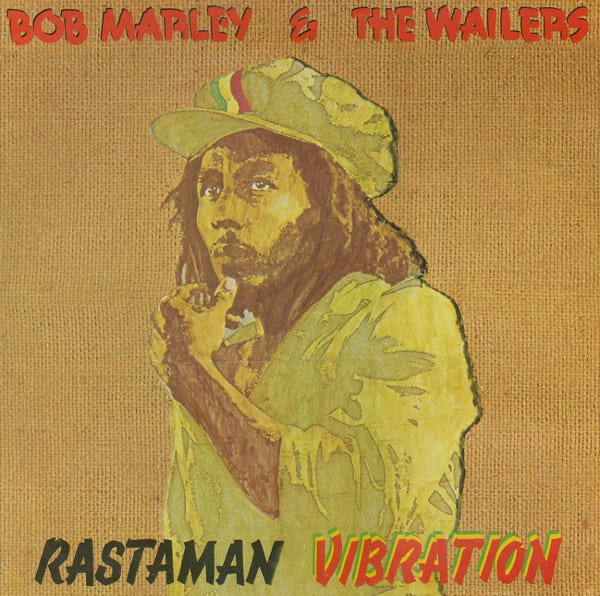
While the casual fan (i.e., the one who gets their fix from Legend) may not be as familiar with Rastaman Vibration, it was a solid follow-up from the previous year’s Live. Powerful statements such as “War” shared space with the laid-back joy of “Roots Rock Reggae.” Marley and the Wailers delivered a perfect midway point between two studio classics—1974’s Natty Dread and ‘77’s Exodus. Marley would end 1976 by being shot by would-be assassins in a home invasion on the eve of performing a free concert, forcing him and the Wailers to leave Jamaica for London.
Bob Dylan - Desire
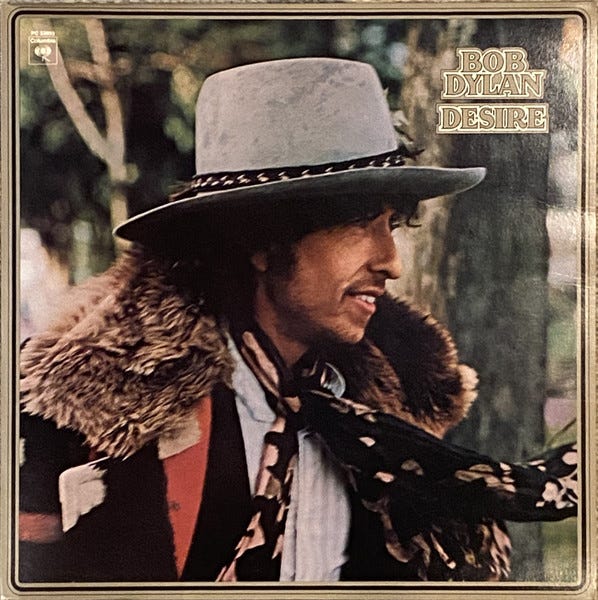
No other album in Bob Dylan’s discography sounds like Desire. That’s partly due to the be-caped Scarlet Rivera, whose violin dances around Dylan’s harp throughout. It’s also because of the overall spillover from his sprawling Rolling Thunder ensemble, backing vocals from Emmylou Harris, and his collaborations with Jaques Levy, who co-wrote most of the songs here. In fact, the only two sole compositions from Dylan are two of the most powerful: the ominous, minor key masterpiece “One More Cup of Coffee” and the shockingly personal “Sara.” Following up such an all-timer as Blood on the Tracks would be no easy feat for most, but Dylan proved once again that he truly exists in the moment, and we’re all the better for it.
Stevie Wonder - Songs in the Key of Life
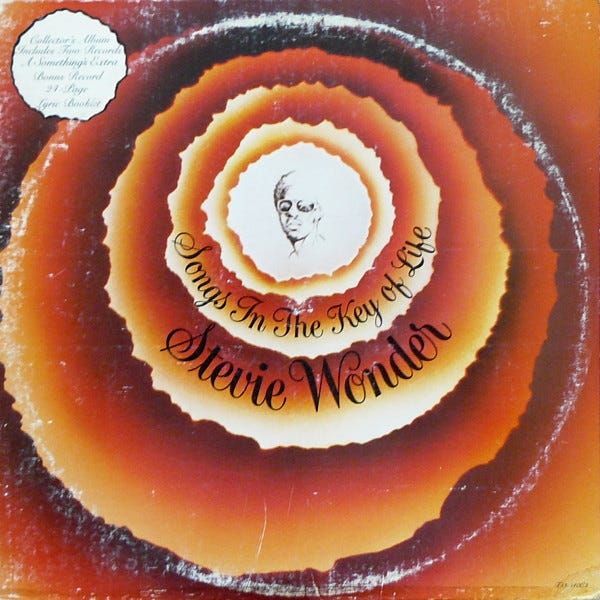
One of the most ambitious and powerful statements of the decade—and beyond—Stevie Wonder’s Songs in the Key of Life remains both exciting and breathtakingly beautiful 50 years on. The sprawling set opens in deceptively subtle fashion with “Love’s In Need of Love Today,” “Have a Talk With God,” and “Village Ghetto Land” before “Contusion” places the prog-fusion-funk at the forefront. From there, it only gets more adventurous and eclectic. Pop, R&B, and jazz provide the foundation for Wonder’s explorations, influencing almost everything that came after.
Ian Hunter - All American Alien Boy
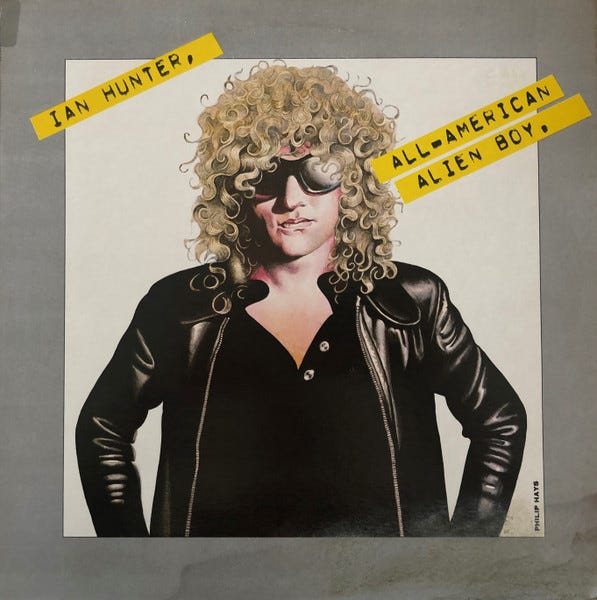
For Hunter’s follow-up to his self-titled debut, he recruited drummer Aynsley Dunbar, keyboardist Chris Stainton, and bassist Jaco Pastorius for an album that doesn’t rock quite as hard as his previous one, nor as hard as what followed with Mick Ronson, but it’s no less fine a listen. The swagger is there with “Restless Youth,” while “You Nearly Did Me In” is all New York City-tinged sax (wielded by David Sanborn) and swaying piano with Queen on backing vocals. It may not be one of Hunter’s most critically acclaimed efforts, but All American Alien Boy is consistently gripping throughout, and one of the best rock albums of a strong year.
Joni Mitchell - Hejira
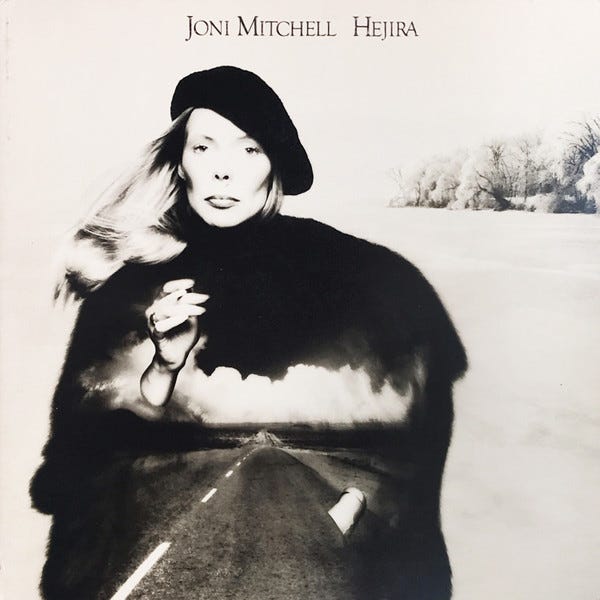
For sure, there’s comfort in the familiar—when artists give their fans what they expect and want. The albums that push boundaries, transcending their time and place, however, are often the ones that remain the most rewarding, even half a century later. Not many fit this description quite like Hejira, where Joni Mitchell—already an adventurous singer/songwriter/guitarist at this point in her career—for the most part jettisoned song structure and melody in favor of explorations in rhythms and groove. Larry Carlton, Jaco Pastorius, John Guerin, Bobbye Hall, and a host of others are along for the ride, helping Mitchell begin the most exciting phase of her career.
Tom Waits - Small Change
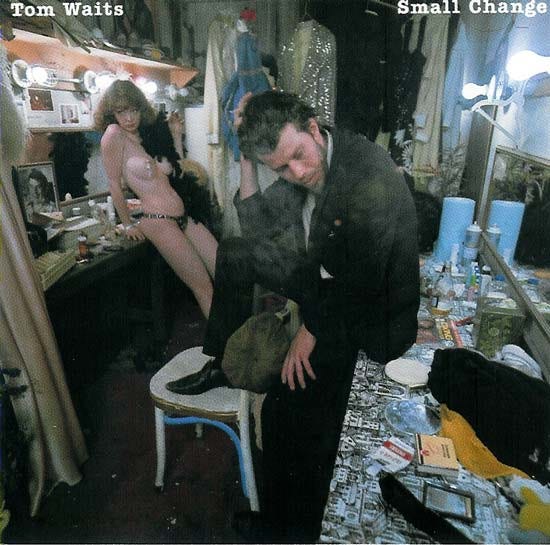
Tom Waits’s fourth album continued his Charles Bukowski-meets-Louis Armstrong jazz-piano-bar-guy persona with another set of classics and near-classics. Sweeping, orchestrated ballads bump up against late-night, black-and-white, lonely blues and offbeat scat-filled observations. One of his most consistent, enjoyable platters of the ‘70s, before he headed to the junkyard for the tools to reinvent himself for the ‘80s.
Boz Scaggs - Silk Degrees
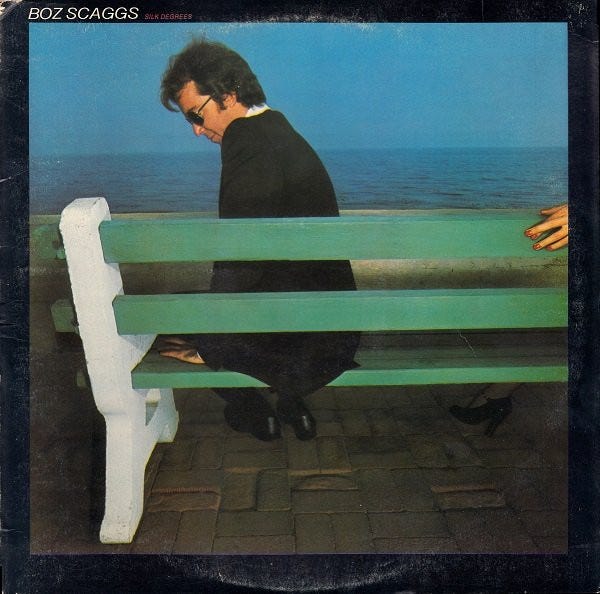
For many, Silk Degrees represents the sound of the latter part of the 1970s. Slick, flawless production; precise, in-the-pocket musicianship (from players that would soon become Toto); and the smooth vocalizing of a guy that started as a Texas blues-rock guitar slinger in Steve Miller’s band. 50 years on, Boz Scaggs’s masterpiece helped kick off a soft rock subgenre retrofitted as “yacht rock” and seemingly everyone—young and old, black, white, and otherwise—knows how to get “Lowdown” with the “Lido Shuffle.”
Bob Seger & the Silver Bullet Band - Live Bullet
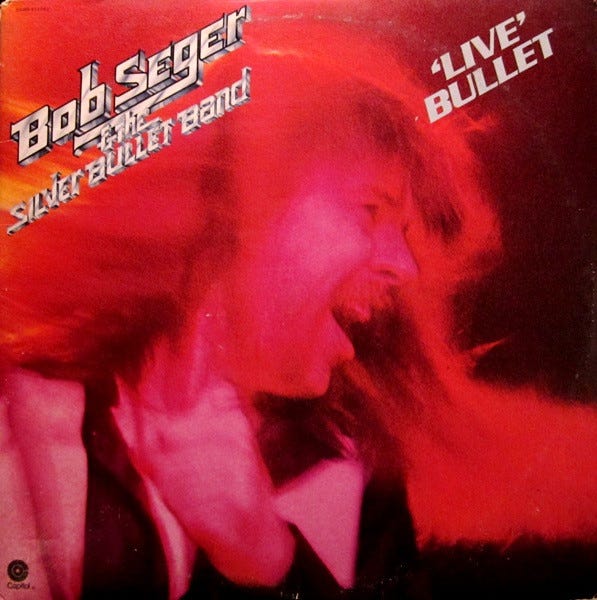
Live Bullet made a bona fide rock star out of a struggling Midwestern singer-songwriter who loved rock’n’roll, soul, R&B, and folk. This is the album that offered Bob Seger the opportunity to show off not only his hard rock chops but also his sensitive side - with ballads that cut much deeper than just a chance to catch your breath between the fist pumps and air guitar. While he could approach James Brown-level funky with “Heavy Music,” Seger could be just as powerful while crafting the perfect marriage of road song and introspective ballad with the inspired pairing of “Travelin’ Man” and “Beautiful Loser,” as well as the mighty “Turn the Page,” each surpassing their studio counterparts. Live Bullet stands as one of the most listenable, entertaining, heart-tugging, chest-pumping live rock’n’roll albums ever recorded.
The Modern Lovers - The Modern Lovers
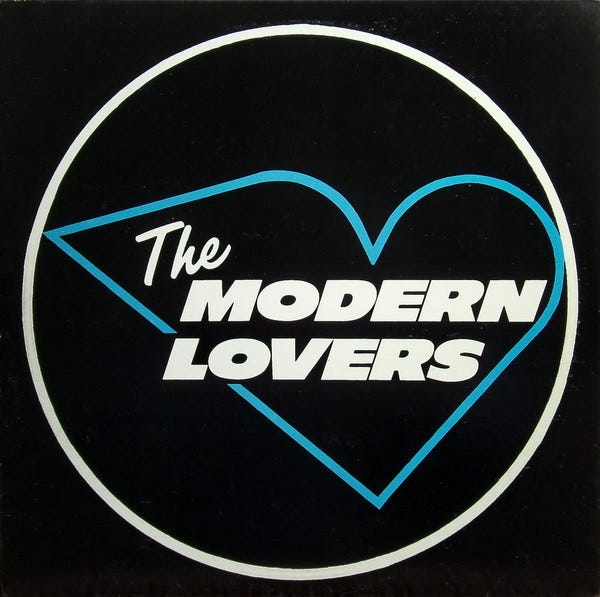
The Modern Lovers provides the bridge between mid-’60s garage rock and mid-’70s punk. All the elements that make rock’n’roll so enticing are evident here. An innocent, naive outlook one moment gives way to a dark, rebellious sneer in another. Mastermind Jonathan Richman would retool and somewhat soften his Modern Lovers on subsequent releases (as he would go on to an eclectic solo career), but their debut (originally recorded in 1973 under the guidance of John Cale) remains an undisputed classic of its time.
Marvin Gaye - I Want You
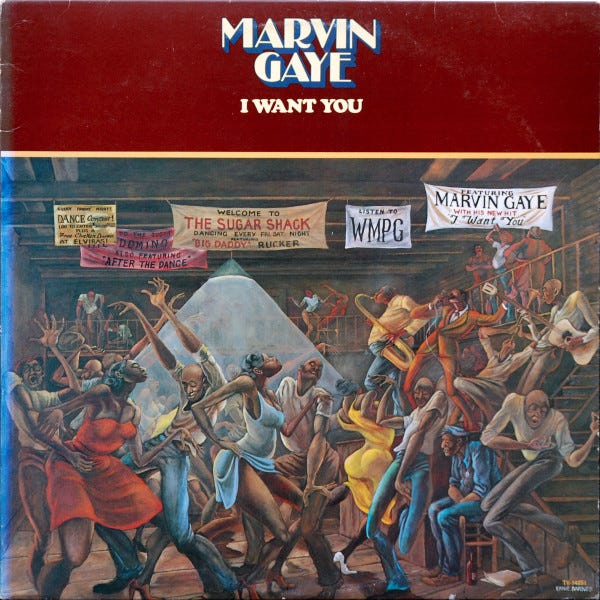
Marvin Gaye’s first album of new material since Let’s Get It On three years earlier, fits perfectly into the sonics of the mid-1970s, thanks in no small part to Leon Ware, whose ideas were co-opted by Gaye and Berry Gordy for what became I Want You. (Ware, in turn, placed his own name on Musical Massage that same year, another classic of the era, and it’s reported Gaye and Gordy wanted those songs, too.) Much of what’s here hints at Gaye’s troubled personal life, including his marriage to Gordy’s sister Anna, the subject of the less ambiguous Here, My Dear, two years later. The sound of I Want You is early quiet storm—smooth and highly erotic—and packed with themes that Gaye knew how to handle with ease.
Graham Parker - Howlin’ Wind
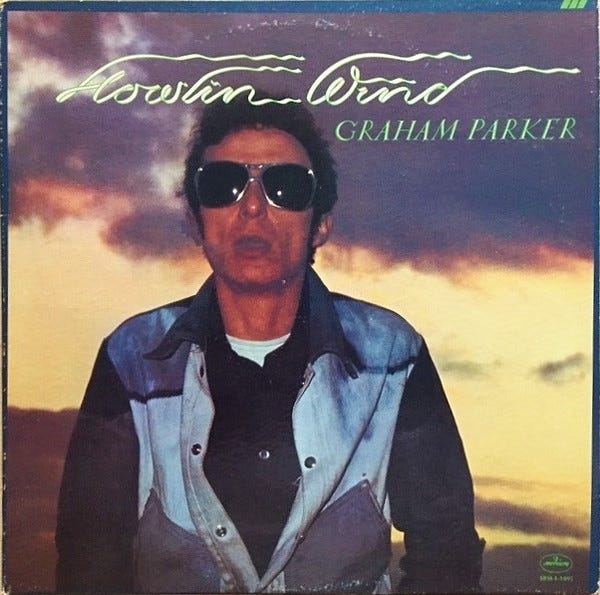
Although Heat Treatment may be the critics’ favorite of Graham Parker’s first two albums in 1976, it’s Howlin’ Wind that laid the groundwork and gets the edge from this writer. Sounding like a messy mix of Dion, Springsteen, Van Morrison, and proto-punk rocker, Parker swaggers and struts throughout Howlin’ Wind, celebrating rock’n’roll—with a nod toward soul—in all its dirty glory.
Led Zeppelin - Presence
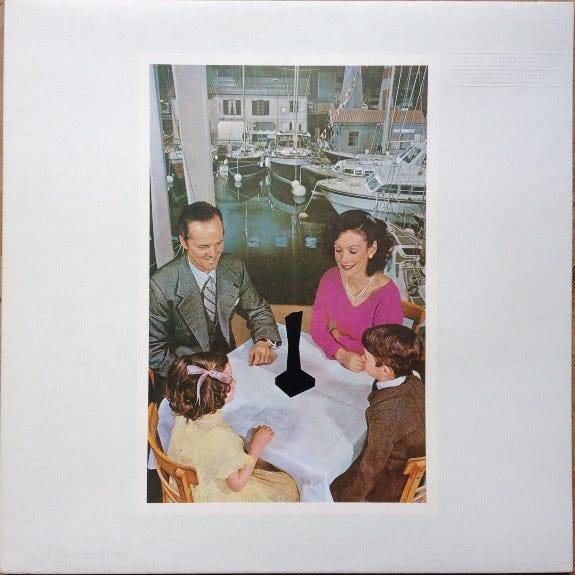
Bookended by a pair of epics that are sonic opposites yet equally powerful, Presence is Led Zeppelin at its most chaotic. Recovering from an auto accident, Plant recorded most of the tracks confined to a wheelchair. That restlessness can be heard in the wanderlust of the majestic “Achilles Last Stand,” containing ten-plus minutes of Page’s riffs and solos building upon each other, Plant’s probing wails, Bonzo’s “Bolero”-type fills, and Jones’s galloping bass. From there, “For Your Life” offers nothing but riff and menace with the push-and-pull of the blues, while Blind Willie Johnson’s “Nobody’s Fault But Mine” is given the epic, ominous Zep treatment. They attempt funk again with “Royal Orleans” and (more successfully with) “Hots On for Nowhere.” After paying tribute to early rock’n’roll on “Candy Store Rock,” “Tea for One” acts as one long exhale after the storm.
Waylon Jennings, Willie Nelson, Jessi Colter, Tompall Glaser - Wanted! The Outlaws
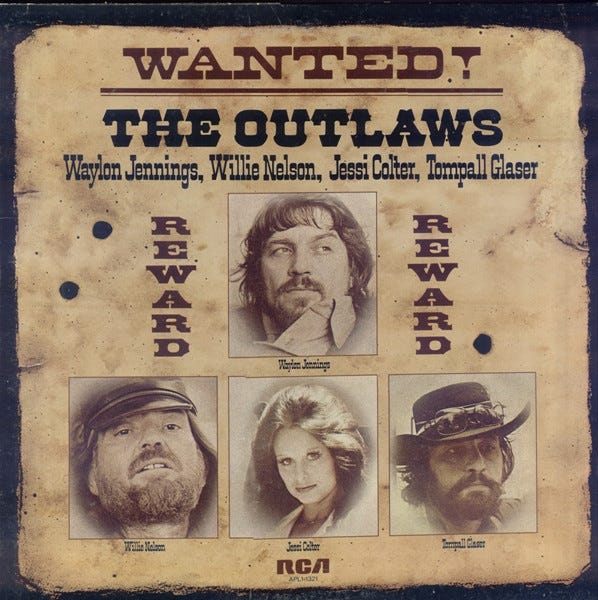
Despite—or maybe due to—consisting of mostly previously recorded material, Wanted! The Outlaws became country music’s first platinum seller, and, in doing so, proved the music of Waylon Jennings, Willie Nelson, Jessi Colter, Tompall Glaser, and a handful of like-minded artists was commercially viable. In other words, it marked the beginning of the end for the Outlaw movement. As an album, what’s here is unimpeachable, and it’s obvious how it became a pivotal moment in country music.
Flamin’ Groovies - Shake Some Action
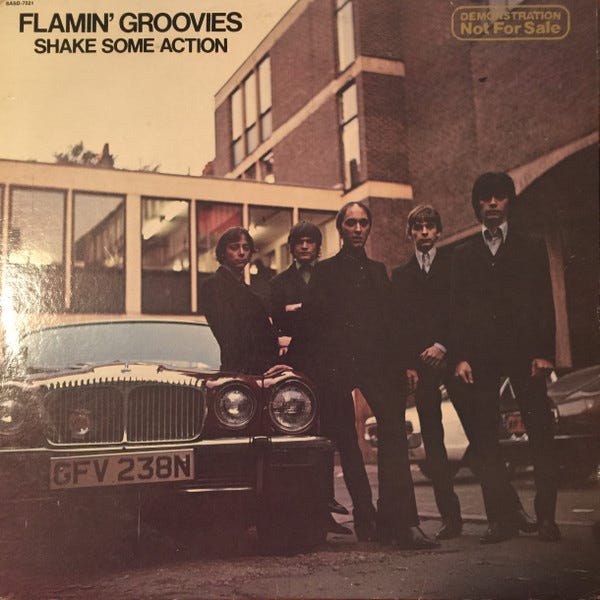
One of the greatest power pop anthems of all time stands as this album’s title cut and lead-off track. Although nothing that follows bests “Shake Some Action,” the rest of the album—as well as its title track—proved that the Flamin’ Groovies were more than just blues-obsessed rockers. Although there were a handful of moments that sonically reached back to the pre-Beatles era, Shake Some Action masterfully blended early rock 'n' roll with the melodic universe Lennon and McCartney helped create.
Boston - Boston
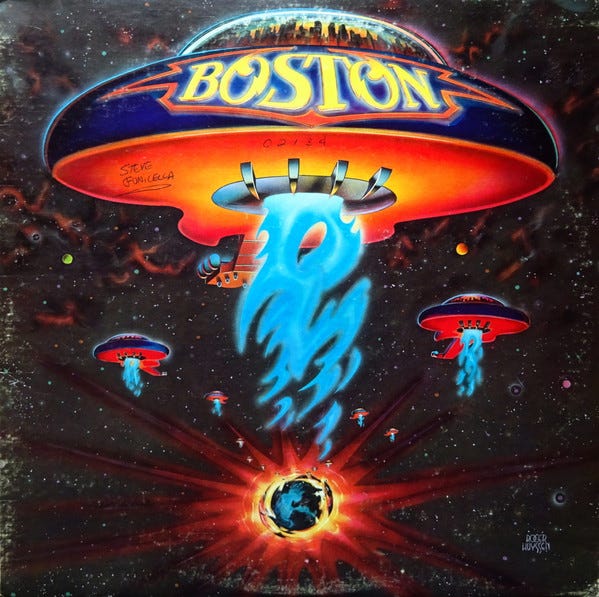
The basis for AOR and classic rock radio for the last 50 years, Boston’s self-titled debut may contain the most overplayed songs ever, but there’s a reason for that. Mastermind Tom Scholz crafted Boston to sound huge, and it does. This is arena rock in all its excess, for better and worse. Brad Delp’s vocals soar over Scholz’s multiple layers of guitars throughout, but it’s more than just the sound; the songs are there, too. Step away from this beast for a while and return to it fresh, and tracks like “More than a Feeling” and “Long Time” still excite, while the overdubbed dual guitars in the coda to “Hitch a Ride” will make your jaded cynicism crumble under the weight of their pure rock’n’roll power.
Ramones - Ramones
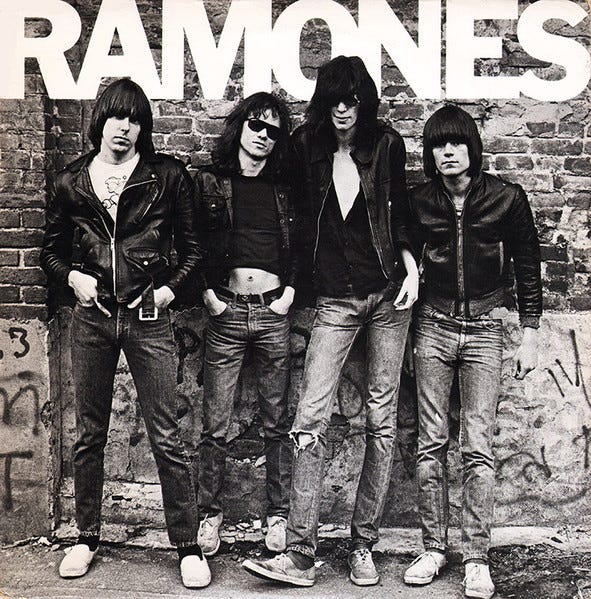
The hint of feedback, anxious countoff, opening guitars, and “HEY HO LET’S GO” chant that launch Ramones is still one of the most exciting moments in all of rock’n’roll. It stood as a statement of purpose like no other in the year when punk was tearing the ivory tower of rock back down to its studs. It thrashes, it defies, it punches up. It’s not all punk power, however; “I Wanna Be Your Boyfriend” displayed a strong pop sensibility underneath all that leather and riffage. Fifty years on, and despite the success of all the Green Days of the world, Ramones is still a shock to the system.
Willie Nelson - The Sound in Your Mind
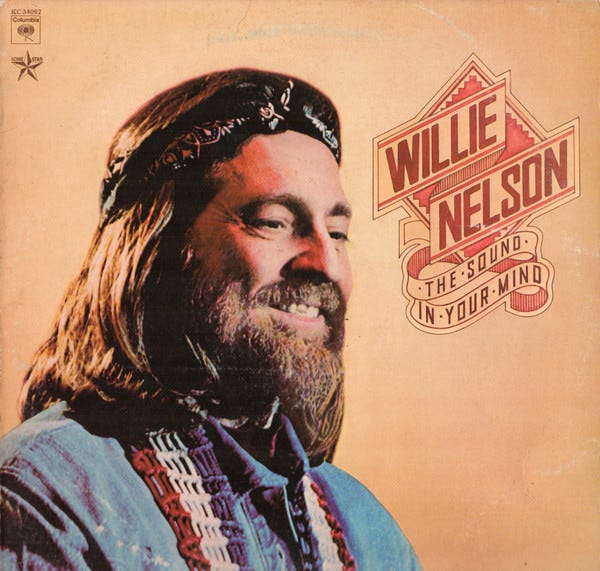
Although not as cohesive an affair as its predecessor, Red Headed Stranger, The Sound in Your Mind allowed Willie Nelson and his band, The Family, the opportunity to stretch out in parts while showcasing Nelson’s strengths as a songwriter and an interpreter. Tracks like “That Lucky Old Sun” pointed the way to his dive into the Great American Songbook on his landmark Stardust two years later, while his take on Lefty Frizzell’s “If You’ve Got the Money, I’ve Got the Time” celebrated Nelson’s honky-tonk roots. Meanwhile, originals such as “Healing Hands of Time” and the title track are presented here in their definitive versions. Even a well-worn standard such as “Amazing Grace” fits perfectly alongside the epic closing medley of three Nelson classics. As fantastic as those moments are, however, his haunting take on Steve Fromholz’s “I’d Have to Be Crazy” is the album's best moment and stands as one of the great country covers of all time.
The Wild Tchoupitoulas - The Wild Tchoupitoulas
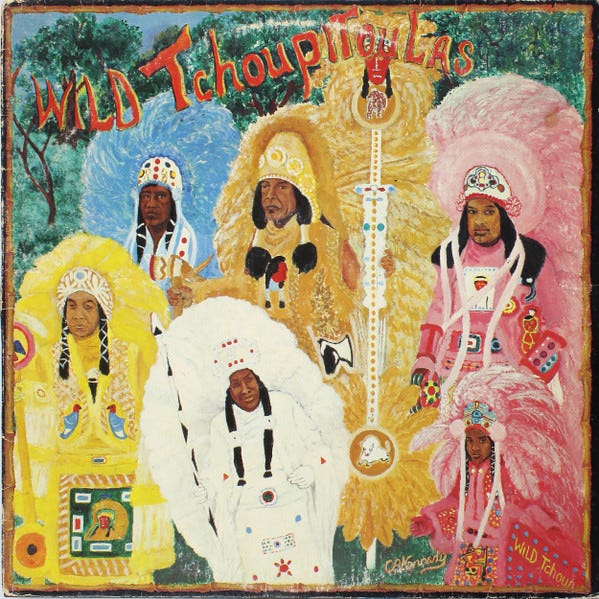
The album that unwittingly sparked the formation of the Neville Brothers, the sole album from The Wild Tchoupitoulas—a collective of Mardi Gras Indians fronted by George “Big Chief Jolly” Landry—was one of the most joyful releases of the year. Landry recruited his nephews, the Nevilles, along with the rest of the Meters, and together they crafted a song cycle that reflected the New Orleans sound in all its rich heritage and glory. Call-and-response vocals and chants mix with funk and soul. It’s the sound of a world where every day is Fat Tuesday.
Warren Zevon - Warren Zevon
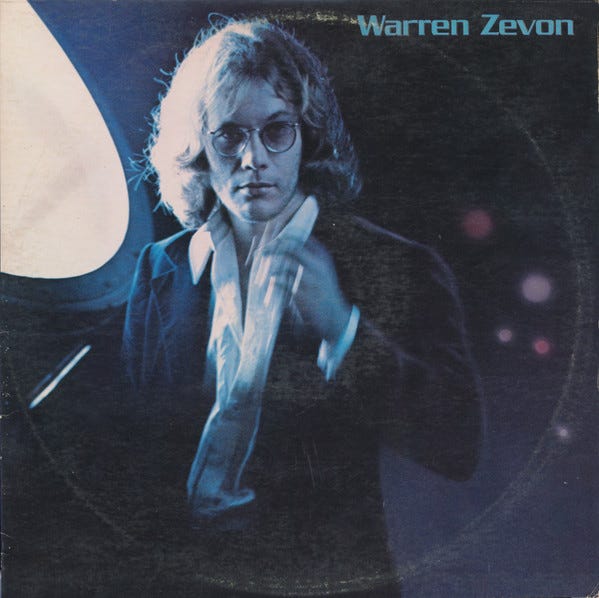
The mid-to-late 1970s saw LA’s mellow mafia at its peak. Artists—most of them on David Geffen’s Asylum label—from Jackson Browne and Linda Ronstadt to the Eagles dominated the charts and the airwaves. None were as subversive lyrically while playing the soft rock game as Warren Zevon. His self-titled sophomore release laid the groundwork for the rest of his career, and included such all-timers as “Poor Poor Pitiful Me,” “Hasten Down the Wind” (both covered memorably by Ronstadt), “Mohammed’s Radio,” and the classic, devastating “Carmelita” (even faithfully covered by GG Allin). Warren Zevon is a standout from an artist who walked his own path up until his untimely end.
Thin Lizzy - Jailbreak
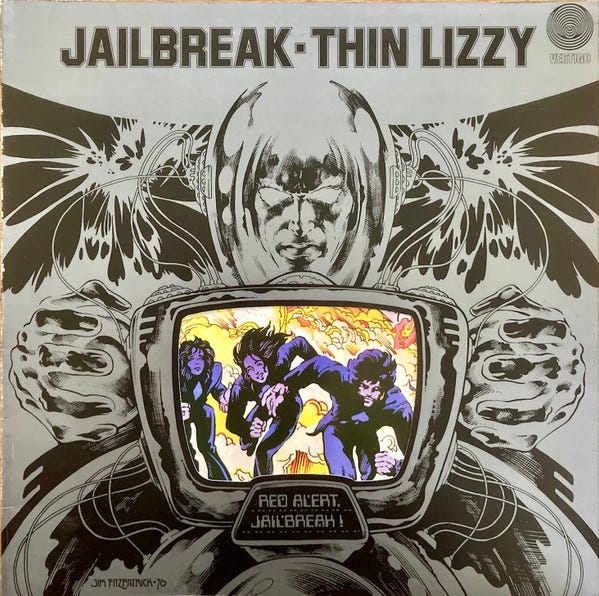
Southern Rock wasn’t the only place to hear twin guitars in ‘76. Thin Lizzy’s Jailbreak placed Scott Gorham and Brian Robertson out front, weaving double lead lines in and around Phil Lynott’s increasingly dense lyrics about cowboys, star-crossed lovers, rose-colored nostalgia, and taking on the world. Jailbreak became Thin Lizzy’s defining moment for good reason, giving FM rock radio plenty of material for years to come while influencing a generation of rockers over the next 25 years.
Jaco Pastorius - Jaco Pastorius
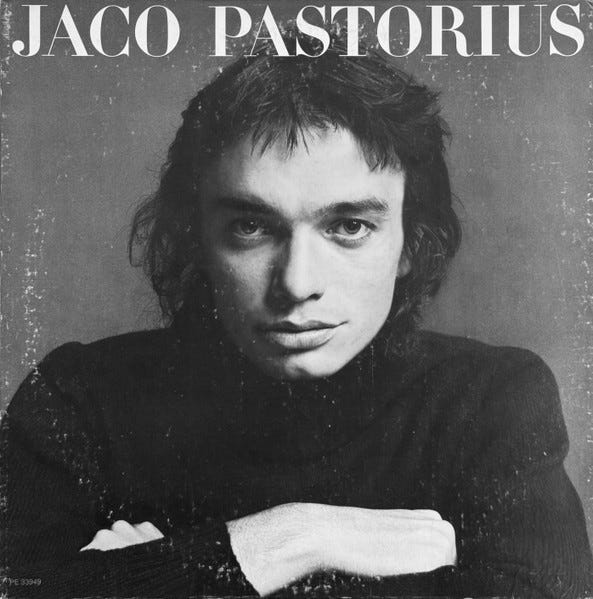
In 1976, it seemed Jaco Pastorius was everywhere: playing on Pat Metheny’s debut, Bright Size Life, joining Weather Report for Black Market, guesting on Ian Hunter’s All American Alien Boy, and on Joni Mitchell’s Hejira. In the midst of all this work, Pastorius found time to record this landmark jazz/fusion debut. His elastic, fretless bass ties these tracks together, making it a cohesive, yet adventurous, classic.
Tom Petty and the Heartbreakers - Tom Petty and the Heartbreakers
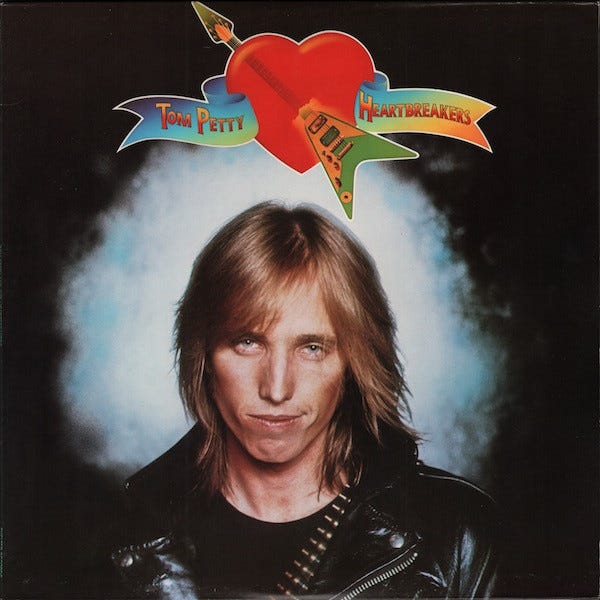
With punk basically making its debut in 1976, record stores and radio didn’t really know what to do with a good ol’ rock’n’roll band. By this point, the suits wanted to place a hyphen in front of all things “rock.” Tom Petty and the Heartbreakers didn’t give a damn. They were down for “Anything That’s Rock’n’Roll.” They would make better albums for sure, but here’s where the template was laid, and they were already giving us all-timers in “Breakdown” and “American Girl.” A debut that still rocks as hard now as it did 50 years ago.
AC/DC - Dirty Deeds Done Dirt Cheap
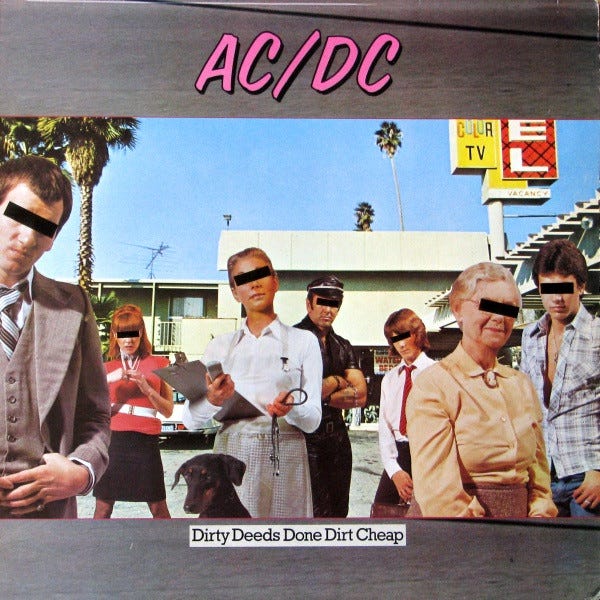
Although those of us in the US didn’t get to hear it until 1981, Dirty Deeds Done Dirt Cheap was unleashed upon the rest of the world in 1976 (the same year we were introduced to High Voltage stateside). Timeline of access aside, AC/DC’s actual third album is filled with a mix of humor and menace that only these guys could deliver with Bon Scott at the helm. This is also where their allegiance to Chuck Berry-inspired rock’n’roll is most evident, as the side two one-two punch of ‘There’s Gonna Be Some Rockin’” and “Ain’t No Fun (Waitin’ ‘Round to Be a Millionaire)” takes the rhunka-rhunka boogie to glorious extremes. The title track is the undeniable classic, but don’t skip the majestic blues of “Ride On,” the closest these bad boys ever got to sentimentality.
Doug Sahm & The Texas Tornados - Texas Rock for Country Rollers
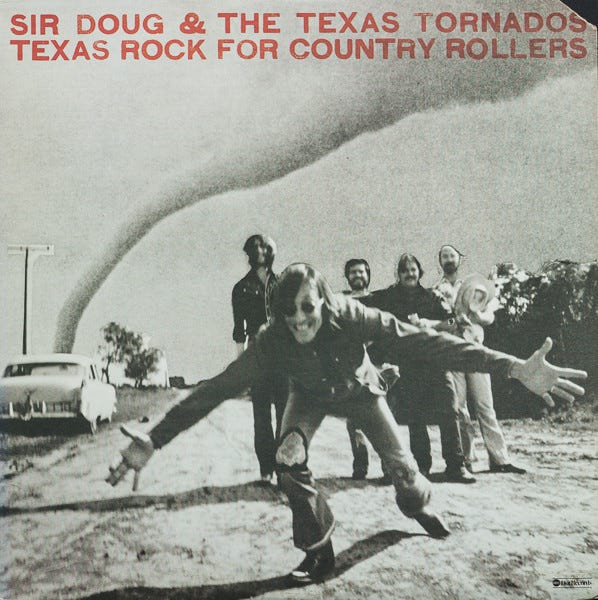
Not to be confused with Doug Sahm’s ‘90s-fronted Lone Star supergroup, the Texas Tornados, the lineup listed on Texas Rock for Country Rollers—aside from Augie Meyers—were an entirely different group. With the Crazy Cajun Huey P. Meaux behind the board, Sahm crafted an all-time progressive country/rock’n’roll/Tex-Mex classic. From the Dylanesque “Give Back The Key To My Heart” and dusty swagger of “Float Away” (which sounds like Aerosmith equipped with a pig cooker and a phase shifter) to the hard country of “Cowboy Peyton Place” and the blues-soaked anthem, “You Can't Hide A Redneck (Under That Hippy Hair),” this is pure Texas music at its damn finest.
Honorable Mentions:
David Bowie - Station to Station
Rush - 2112
Peter Frampton - Frampton Comes Alive!
Bootsy Collins - Stretchin’ Out in Bootsy’s Rubber Band
Guy Clark - Texas Cookin’
Eagles - Hotel California
Steely Dan - The Royal Scam
Jeff Beck - Wired
Bad Company - Run With the Pack
Ry Cooder - Chicken Skin Music
ABBA - Arrival
Bob Seger and the Silver Bullet Band - Night Moves
Steve Miller Band - Fly Like an Eagle
Peter Tosh - Legalize It
JJ Cale - Troubadour
Dr Feelgood - Stupidity
Frank Zappa - Zoot Allures
Joan Armatrading - Joan Armatrading
The Stills/Young Band - Long May You Run
Waylon Jennings - Are You Ready for the Country
Lynyrd Skynyrd - One More From the Road
Genesis - A Trick of the Tail
KISS - Destroyer
Brand X - Unorthodox Behaviour
Rolling Stones - Black and Blue
The Big 76 from ‘76 Mixtape:
Now, for all of the above plus 26 more, here’s a Mixtape of The Big 76 from ‘76.
When I started building this Mixtape, I ended up with double the songs it now holds. I had to engage in some serious and painful darling killing, but hopefully what’s left successfully illustrates that 1976 was one eclectic and powerful year.
You’ll see/hear some tunes from albums that almost made the list, as well as a handful of well-worn pop favorites, but within reason. You’ll find no “Afternoon Delight” or “Muskrat Love.” For goodness sake, I’m not a monster.
As always, the following Mixtape was carefully sequenced to maximize enjoyment, but if you’d rather just hit “shuffle,” feel free. (Although I will be over here silently judging you.)
If you see any of your favorites missing, please let me know in the comments. No matter how much time I put into these things, I always miss something obvious. It’s maddening.
Happy streaming!
Further Reading:
The Best of 1975

Jaws was the hit of the year at the box office. It signaled a change from the gritty realism—and sometimes nihilism—of late ‘60s/early ‘70s cinema, into a new era of blockbusters spearheaded by Steve…
Truth'll Set You Free: Talking With Mother's Finest About 'Another Mother Further'

“You funny,” Joyce ‘Baby Jean’ Kennedy grins while I’m asking my first long-winded - and, I admit, mostly rhetorical - question: Why wasn’t Mother’s Fines…
The Best of 1979

The last year of the 1970s gave us quite a few cinema classics. Apocalypse Now and The Amityville Horror each haunted us in different ways, The Jerk gave us Steve Martin at his wild and craziest, and
And—as of this writing—the only.
See, kids? The ‘70s were a mess, too.
https://www.fordlibrarymuseum.gov/digital-research-room/library-collections/topic-guides/nixon-pardon
https://www.archives.gov/research/guide-fed-records/groups/452.html
https://www.worthpoint.com/worthopedia/1976-bicentennial-world-book-1833376743
https://ew.com/family-feud-contestants-herpes-tests-richard-dawson-book-8407680
OK, that was pretty much a rumor started by Barris himself. They even made a movie about it, based on his memoir, Confessions of a Dangerous Mind.
Usually, those judges included Jamie Farr, Jaye P. Morgan, and Arte Johnson, but sometimes Phyllis Diller and Adrienne Barbeau, among others, appeared.
Let’s pause for a moment to appreciate the incredible voice work of Percy Rodriguez, who voiced both trailers above, Taxi Driver and The Omen. I know Don LaFontaine gets most of the love in the world of movie trailers (he did, after all, popularize the “In a world…” opening), but no voice was as unsettling in a darkened theater as Rodriguez’s.
Technically, they’re called “Eagles” without the “The.” Admittedly, it does add a bit of pretentious mystery to their moniker, although in all my radio days, I never once introduced them as “Here are Eagles…” That would be silly.
It could’ve been subtitled, “The Bernie Years.”
It’s also, as of this writing, the first album to be certified 40x platinum by the RIAA. That’s four diamonds in music biz speak.
Le sigh.
In 1976 I was 13 and listening to Barry Manilow, Melissa Manchester, Fleetwood Mac, Heart, and Captain & Tennille!
I was happily oblivious to nearly all of that! But 1976 was memorable for other things. The year I married.